Pericyclic Reactions
The question this page answers: How do we classify cyclic concerted reactions?
Deeper reading: Clayden 2e: Chapter 34 Pages 877–908 and Chapter 35 Pages 909–930 — see our chapter-by-chapter practice map for Clayden.
The four classes of pericyclic reactions
What do pericyclic reactions have in common?
Pericyclic reactions are concerted and go through cyclic transition states.
This class of reactions encompasses a variety of transformations in which the reacting orbital(s) are overlapped in a continuous cycle. Pericyclic reactions can be categorized by the change in # of σ and π bonds:
| Name | Bond Changes | |
|---|---|---|
| Sigma | Pi | |
| Cycloaddition (and Cycloreversion) | +2 (–2) | –2 (+2) |
| Electrocyclic Ring-Closing (and Ring-Opening) | +1 (–1) | –1 (+1) |
| Sigmatropic Reaction | 0 | 0 |
| Ene Reaction | +1 | –1 |
Cycloadditions and cycloreversions
How do two π systems become a ring?
Cycloaddition reactions result in the formation of a new ring from two π systems. Cycloreversion reactions break apart a ring to form two π systems.
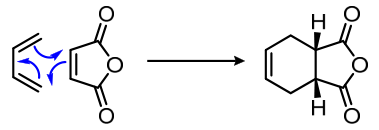
Here is a [4 + 2] cycloaddition:
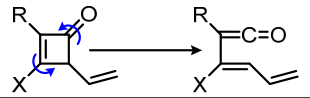
Here is a 4π electrocyclic ring-opening for comparison:
Covered in depth: Cycloadditions and Diels-Alder Reactions.
Electrocyclic reactions
What does an electrocyclic reaction look like?
Electrocyclic reactions can either form a ring or open a ring.
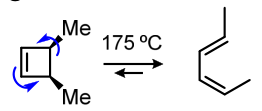
Here is a 4π electrocyclic ring-opening:
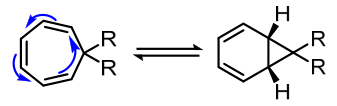
Here is a 6π electrocyclic ring-closing:
Covered in depth: Electrocyclic Reactions.
Sigmatropic reactions
Which pericyclic reactions are rearrangements?
Sigmatropic reactions are also recognized as rearrangement reactions.
Here is a [1, 5] sigmatropic H-shift:
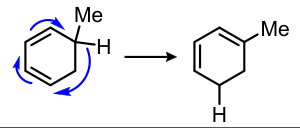
Covered in depth: Sigmatropic Reactions.
The ene reaction
What reacts in an ene reaction?
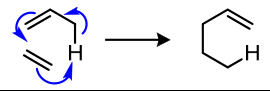
In the ene reaction, a π bond reacts with an allylic hydrogen.
Here is an ene reaction:
Stereospecificity and the Woodward-Hoffmann rules
What controls whether a pericyclic reaction is allowed?
Pericyclic reactions proceed with stereospecificity that depends on: 1) the # of π electrons 2) the reaction conditions.
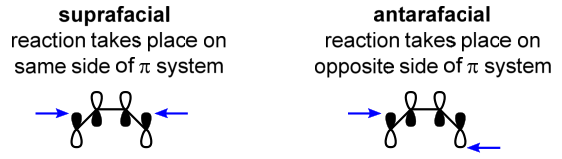
The Woodward-Hoffmann Selection Rules, which derive from analyses of orbital symmetry at the ends of the π MOs, are applied to determine the nature of the cyclization process, which depends on whether the π systems are reacting antarafacially or suprafacially.
A given pericyclic process will only be allowed under either thermal conditions or photochemical conditions, not both.
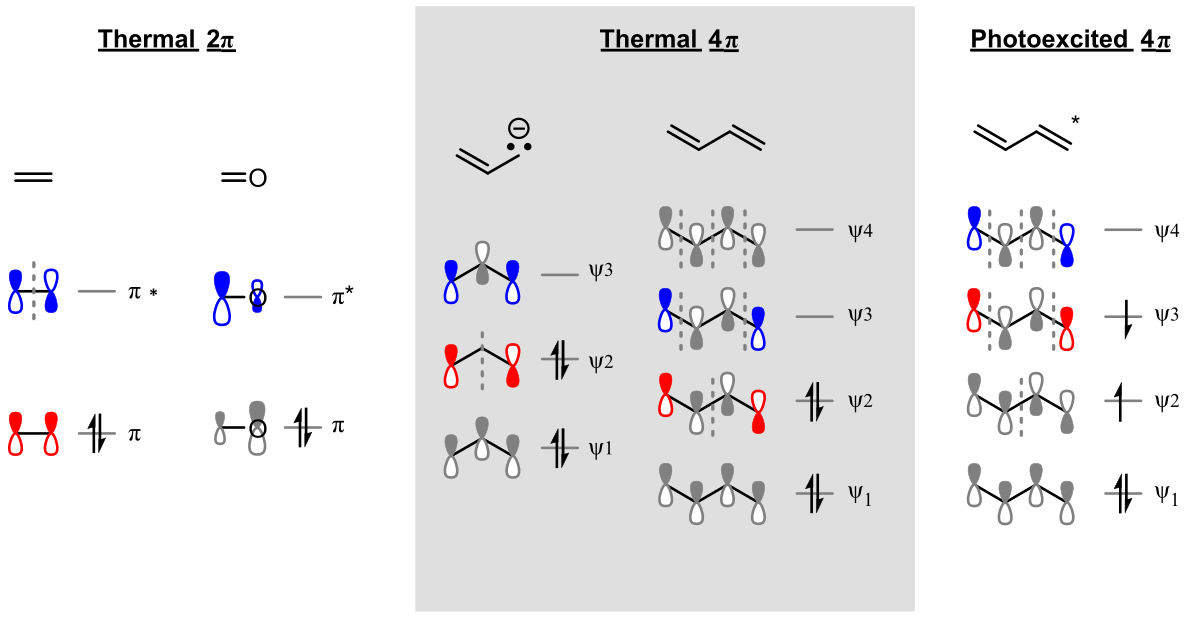
Under thermal conditions,
- 4n systems have HOMO ends that look like the 4π system (i.e. opposed)
- 4n+2 systems have HOMO ends that look like the 6π system (i.e. aligned)
Under photochemical conditions the pattern is reversed because an electron is promoted to a higher energy orbital, causing the ground state LUMO to become the excited state HOMO.
The dedicated guides: Cycloadditions and Diels-Alder Reactions, Electrocyclic Reactions, and Sigmatropic Reactions.
Spotted an error, or want a topic covered next? Let us know.