Sigmatropic Reactions
This guide is an early version — the text is complete, and a few figures are still being redrawn. Spotted something unclear? Let us know.
The question this page answers: What are the characteristics of sigmatropic reactions?
Deeper reading: Clayden 2e: Chapter 35 Pages 909–922 — see our chapter-by-chapter practice map for Clayden.
Part of the Pericyclic Reactions overview.
The [x, y] nomenclature
What do the numbers in [1, 5] mean?
Nomenclature for sigmatropic reactions describes them as being [x, y] processes.
In the [x, y] nomenclature, the x and y describe the position of the atoms in the new σ bond relative to the original σ bond’s location, which is designated as [1, 1]:
![In the [x, y] nomenclature, the x and y describe the position of the atoms in the new σ bond relative to the original σ bond’s location, which is desi](img/fig-01.png)
Allowed sigmatropic shifts
Which sigmatropic shifts are allowed?
A simplified consideration of MOs is to look at the LUMO of the π system and the HOMO of the group that is “moving”.
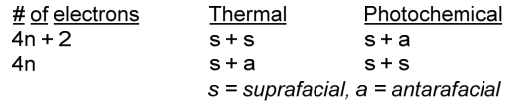
Here are the Woodward-Hoffmann Rules for allowed sigmatropic processes:
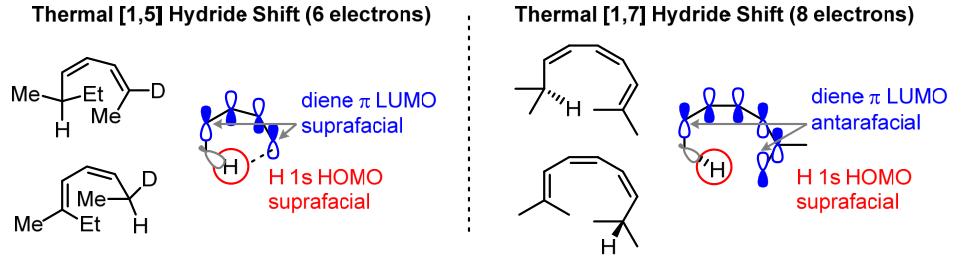
Here are some examples for hydride shifts:
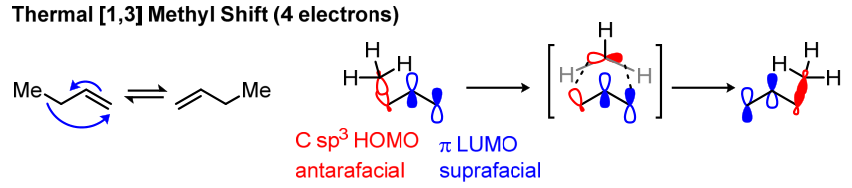
Here is an example for a methyl shift in which the methyl group is inverted:
Spotted an error, or want a topic covered next? Let us know.