Electrocyclic Reactions
This guide is an early version — the text is complete, and a few figures are still being redrawn. Spotted something unclear? Let us know.
The question this page answers: What are the characteristics of electrocyclic reactions?
Deeper reading: Clayden 2e: Chapter 35 Pages 922–930 — see our chapter-by-chapter practice map for Clayden.
Part of the Pericyclic Reactions overview.
Counting electrons: 4π and 6π processes
How do we name an electrocyclic reaction?
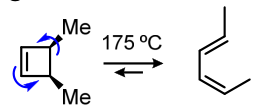
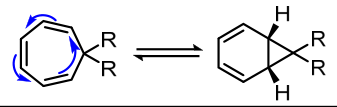
Electrocyclic reactions are described by the number of electrons involved in the process.
Here is a 4π electrocyclic ring-opening:
Here is a 6π electrocyclic ring-closing:
Conrotatory vs. disrotatory motion
Which way do the ends of the π system rotate?
The Woodward-Hoffmann Rules tell us that electrocyclic reactions take place stereospecifically.
The rules describe whether the two atoms at the ends of the π system rotate in the same direction (conrotatory) or in opposite directions (disrotatory).

Different π MOs are required under different reaction conditions in order to have the same phasing required for orbital overlap. Here are the Woodward-Hoffmann Rules for allowed electrocyclic reactions:

Torquoselectivity
When does the direction of rotation matter?
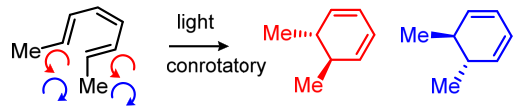
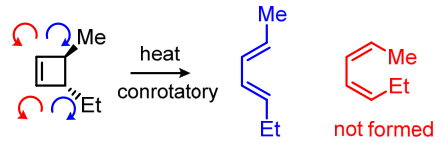
Electrocyclic reactions can potentially display torquoselectivity between the two possible rotations for a given process.
Torquoselectivity is usually unimportant in electrocyclic ring-closing reactions because the possible products are enantiomers and are thus formed in equal amounts:
In electrocyclic ring-opening reactions, however, sterics can favor one product over the other:
Spotted an error, or want a topic covered next? Let us know.