Cycloadditions and Diels-Alder Reactions
This guide is an early version — the text is complete, and a few figures are still being redrawn. Spotted something unclear? Let us know.
The question this page answers: What are the characteristics of cycloaddition reactions?
Deeper reading: Clayden 2e: Chapter 34 Pages 877–908 — see our chapter-by-chapter practice map for Clayden.
Part of the Pericyclic Reactions overview.
The [p + q] nomenclature
What do the numbers in [4 + 2] mean?
Cycloaddition/cycloreversion reactions are given a nomenclature of [p + q].
The q and p in [p + q] refer to the number of electrons in each of the reacting π systems:
![The q and p in [p + q] refer to the number of electrons in each of the reacting π systems:](img/fig-01.png)
Selection rules for cycloadditions
Why heat for [4 + 2] but light for [2 + 2]?
The simplified Woodward-Hoffmann Rules says that: 1) [2 + 2] cycloadditions take place under photochemical reaction conditions. 2) [4 + 2] cycloadditions take place under thermal reaction conditions.
In more detail, for a [p + q] cycloaddition, these are the selection rules:
![In more detail, for a [p + q] cycloaddition, these are the selection rules:](img/fig-02.png)
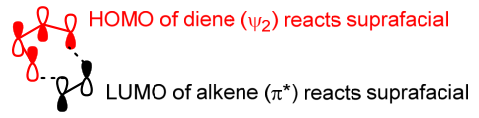
In general, it is more common for cycloadditions to take place between two π-systems that are both reacting suprafacially. Here is an analysis for a [4 + 2] cycloaddition, where we are looking at the HOMO of the diene and the LUMO of the monoene:
The Diels-Alder reaction
What reacts with what in a Diels-Alder reaction?
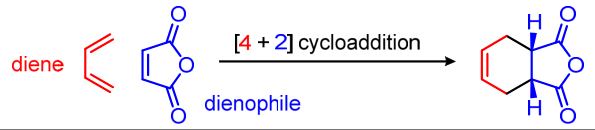
The Diels-Alder reaction refers specifically to [4 + 2] cycloadditions.
The cycloaddition reaction breaks two π and makes two σ bonds, and is exothermic by ~40 kcal/mol. In conventional Diels-Alder reactions, an electron-poor dienophile reacts with an electron-rich diene, which are analogous to electrophile and nucleophile, respectively:
The retro-Diels-Alder reaction
Can a Diels-Alder reaction run in reverse?
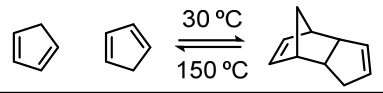
The Diels-Alder reaction is reversible in what is called the retro-Diels-Alder reaction.
At higher temperatures, entropy becomes important and the cycloreversion is favored:
Stereoselectivity: endo, exo, and the s-cis diene
Which product wins: endo or exo?
Diels-Alder reactions are stereoselective.
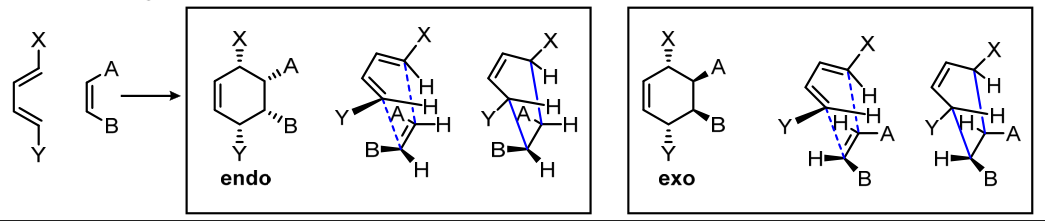
The endo product is favored over the exo product because the endo product is formed via a transition state that has stabilizing π-π interactions:

The diene must be in a s-cis conformation in order to react, which leads some dienes to be more difficult to conduct Diels-Alders reactions with:

The groups at the ends of reacting π systems will end up predictably either cis or trans to each other, depending on whether the reaction is endo or exo:
Electronic effects on reactivity
Which dienes and dienophiles react fastest?
The electronics of the diene and dienophile affect reactivity.
More electron-poor dienophiles are more reactive:

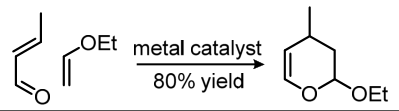
Inverse-demand Diels-Alders reactions are cases where the dienophile is electron-rich and the diene is electron-poor:
Regioselectivity: “ortho” and “para” products
Where do the substituents end up in the product?
Typical Diels-Alder reactions are regioselective and proceed to form “ortho” or “para” products.
The regioselectivity arises from electronic matching between reactants. 1-Substituted dienes react to yield “ortho” products, often exclusively:

2-Substituted dienes react to yield “para” products preferentially:

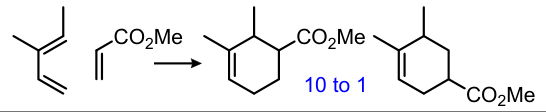
The 1-substituent is more directive than the 2-substituent:
Lewis acid catalysis
How do we make a Diels-Alder reaction faster and more selective?
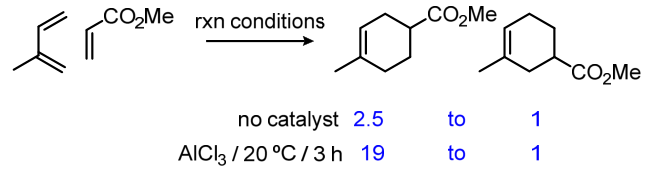
The use of Lewis acid catalysts improves Diels-Alder reaction rates and regioselectivities.
Lewis acids enhance the electrophilicity of the dienophile, leading to improved regioselectivity and reaction rate:
Spotted an error, or want a topic covered next? Let us know.