pKa and Acid–Base Chemistry
The question this page answers: how do we evaluate the acidity and basicity of molecules — and predict which side of an acid–base reaction is favored?
Deeper reading: Clayden, Organic Chemistry 2e, ch. 8 (pp. 163–181) — see our chapter-by-chapter practice map for Clayden.
Acids, bases, and conjugate pairs
What happens when an acid meets a base?
In a Brønsted–Lowry acid–base reaction, an acid and a base exchange a proton (H+), forming a conjugate base and a conjugate acid.
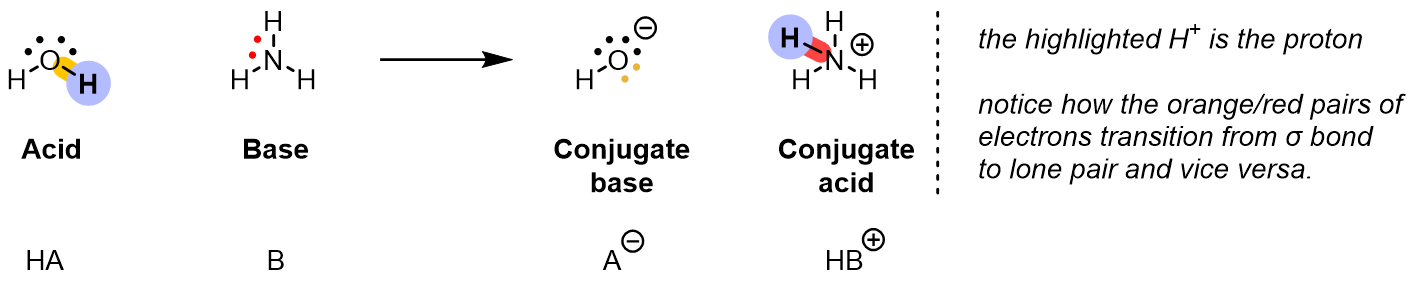
Organic chemists care about acid–base reactions for two reasons: trends in acid and base strength correlate with trends in reactivity more broadly, and many organic reactions contain acid–base steps inside their mechanisms.
Ka and pKa: putting a number on acidity
What does a pKa value actually measure — and why not just use pH?
pKa compresses the enormous range of measured acidities onto a convenient log scale: pKa = −log10 Ka. Stronger acids have lower pKa values.
Ka is the equilibrium constant for an acid's dissociation, Ka = [A−][H+]/[HA]. Because measured Ka values span dozens of orders of magnitude, it is far more convenient to compare acids by exponent than by absolute value — that is all pKa is.
Two consequences worth internalizing:
- A difference of 1 pKa unit is a factor of 10 in acidity. Given pKa(HCl) = −7 and pKa(acetic acid) = 5, HCl is 1012 times the stronger acid.
- You may be used to pH from general chemistry — but pH describes a solution. Organic chemists work in many solvents besides water, so we characterize the molecule using pKa instead.
Predicting equilibria with pKa
Which side of an acid–base equilibrium is favored?
Acid–base reactions favor the side with the weaker acid (the higher pKa).


The six factors that control acidity
What structural factors make an acid stronger?
Stronger acids have more stable conjugate bases. Every pKa trend below is really a statement about how well the lone pair in the conjugate base is stabilized.
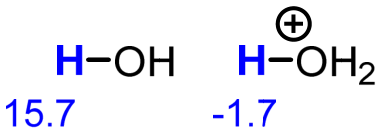
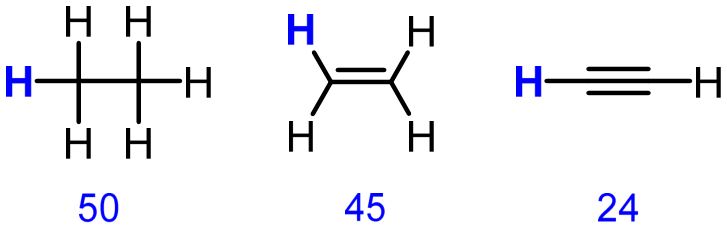
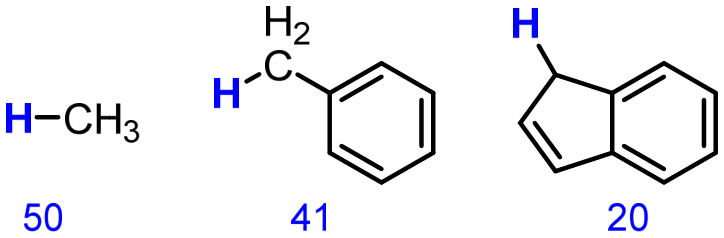
Here they are in rough order of importance. In each figure, the pKa of the bolded blue H is shown in blue.
1. Formal charge
Acids with formal (or partial) positive charge are more acidic:
2. Element effects
H's on more electronegative atoms are more acidic (across a row of the periodic table):

H's on more polarizable atoms are more acidic (down a column):

3. Hybridization
Hybrid orbitals with more s character hold their electrons closer to the nucleus — they behave as if more electronegative:
4. Resonance
Delocalization can dramatically stabilize the conjugate base:
5. Inductive effects
Electronegative atoms two to three bonds from the acidic site stabilize the conjugate base through σ bonds:

6. Solvation
Ions like to be solvated, so steric bulk that blocks solvation makes the conjugate base less stable — and the acid weaker:

Lewis acids and bases
What if no proton is transferred — what are Lewis acids and bases?
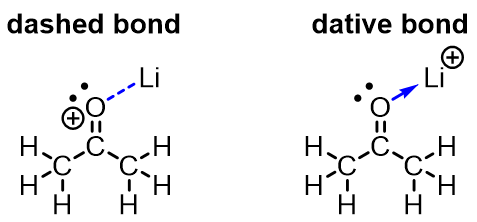
Lewis acid–base reactions are the broader category: any lone pair (Lewis base) interacting with an empty orbital (Lewis acid).

Organic chemists use Lewis acids to accentuate positive charge in a molecule and to stabilize species through bond formation. Because both electrons of the new bond come from one atom, this bond is sometimes drawn with special notation:
More Practice for this Topic
pKa intuition is built by making calls on real molecules, not by rereading trends. Try it:
- Find the Acidic Proton — click the most acidic H in each molecule (O–H, N–H, and C–H acids)
- pKa Comparison (DMSO) — pick the more acidic of two structures and learn DMSO pKa values
- pKa Comparison (Water) — the same game with aqueous pKa values
Spotted an error, or want a topic covered next? Let us know.