Structure and Bonding
This guide is an early version — the text is complete, and a few figures are still being redrawn. Spotted something unclear? Let us know.
The question this page answers: How do atoms come together to form molecules? How do organic chemists simplify this thinking for molecules containing many atoms?
Deeper reading: Clayden 2e: Chapter 4 Page 80–106 — see our chapter-by-chapter practice map for Clayden.
Mixing atomic orbitals into molecular orbitals
How do atomic orbitals combine?
To define the nature of bonding between atoms in a molecule, we “mix” atomic orbitals (AOs) together to create molecular orbitals (MOs).
This mixing process is called linear combination of atomic orbitals (LCAO).
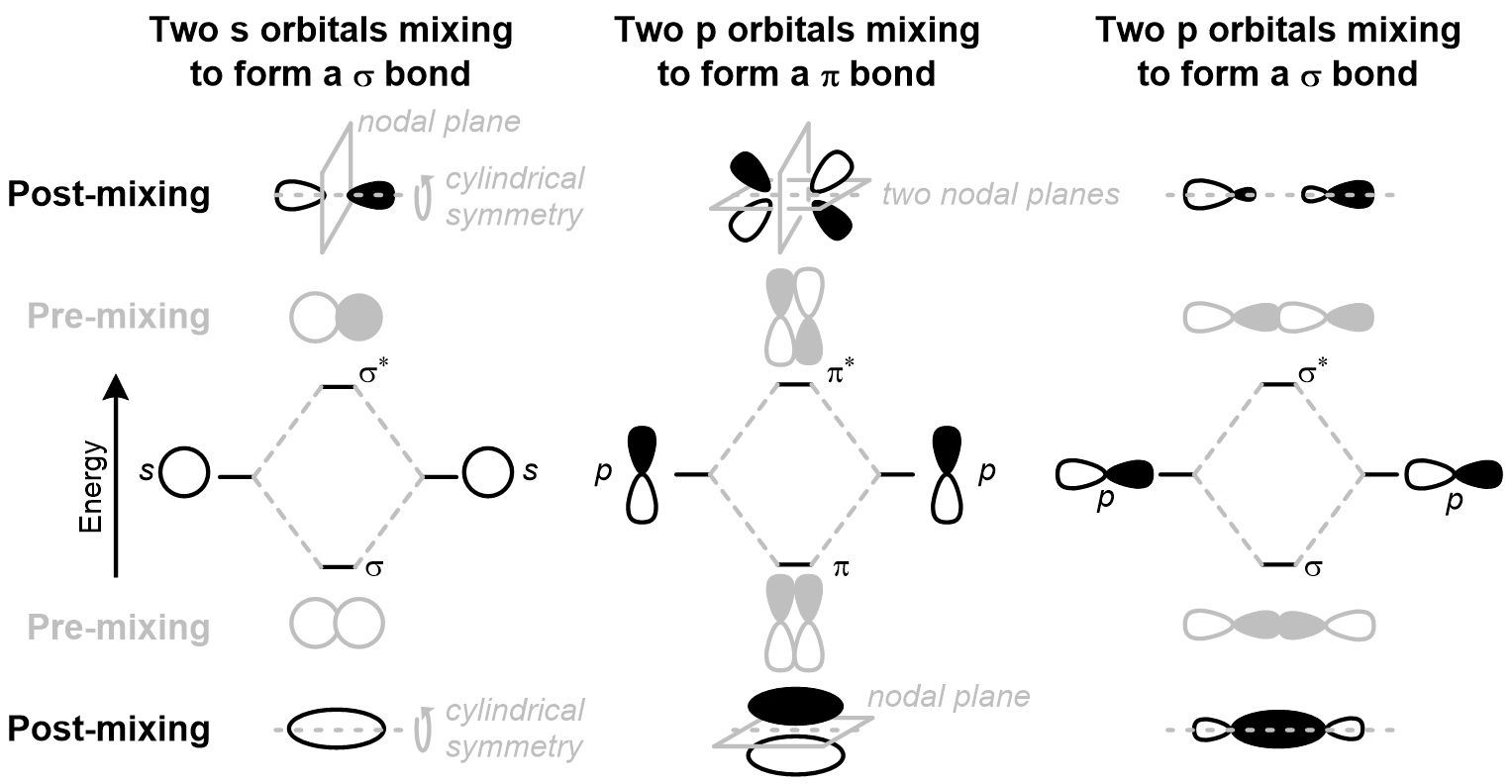
MOs are created by mixing AOs together both in-phase (constructively) to generate a bonding MO and out-of-phase (destructively) to generate an anti-bonding MO (indicated by a *). These MOs can be either sigma (σ) or pi (π)-type in nature:
- Sigma (σ) bonds are created by head-to-head overlap of two sp3, sp2, sp, and/or s orbitals. Sigma bonds have cylindrical symmetry around the interatomic axis.
- Pi (π) bonds are created by side-to-side overlap of p orbitals. There is a nodal plane containing the interatom axis.
Here are some examples of generic orbitals mixing together:
Molecular orbital theory
Which molecules can we solve by hand?
For diatomic molecules, it is possible to consider all the AOs of the atoms mixing together to create an equal number of MOs without the aid of a computer. This method of simultaneous mixing of AOs falls under molecular orbital theory.
Here are MO diagrams for N2 and CO:
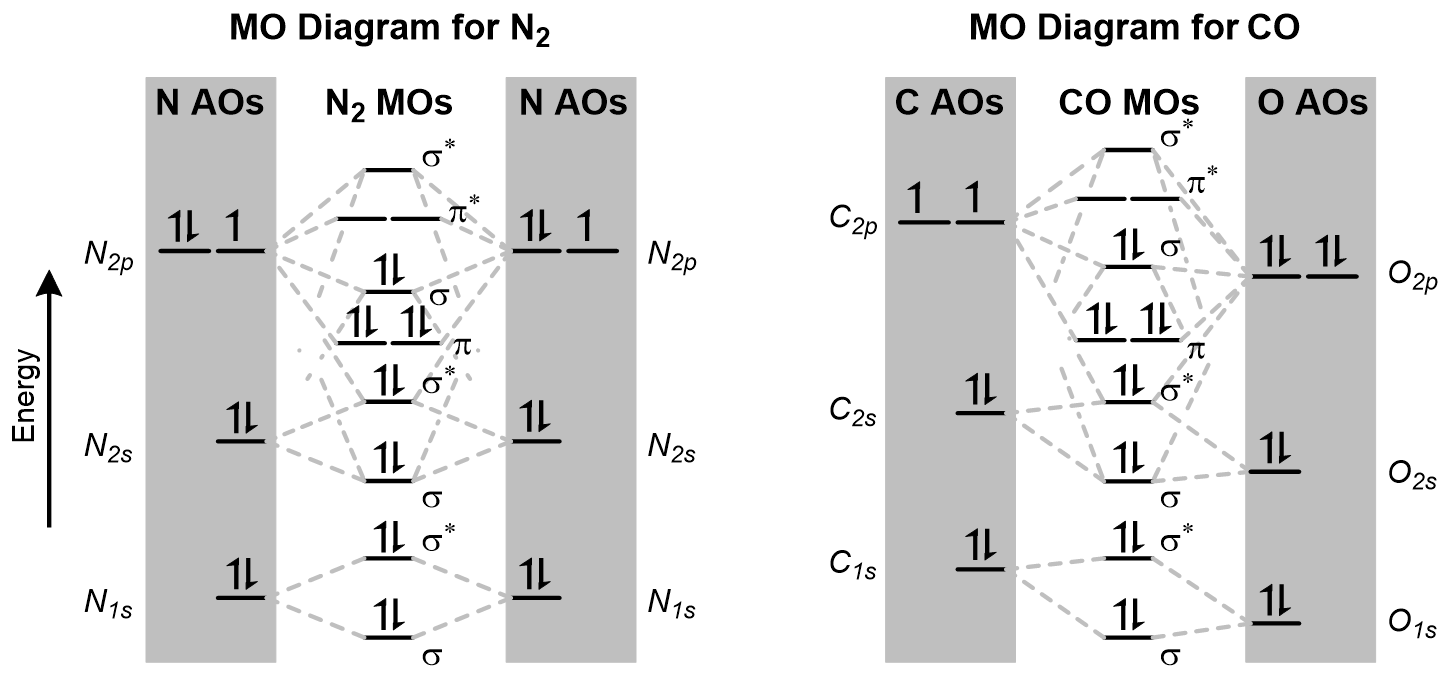
Notice that more electronegative atoms have more stabilized atomic orbital energies. One consequence of this stabilization is that bonding orbitals are usually skewed toward the more electronegative atom, and vice versa for anti-bonding orbitals. We will revisit this idea.
Learning how to create these MO diagrams takes place in physical and inorganic chemistry courses. For now, it’s enough to realize that true MO diagrams are complicated.
Hybrid atomic orbitals and valence bond theory
How do we handle bigger molecules?
For molecules with more than two atoms, these MO diagrams are too complicated for us to generate by hand. The approximation we make to simplify this problem is to pre-mix AOs on atoms and create hybrid atomic orbitals (HAOs) that match real atomic and molecular geometries.
Here are the types of orbital hybridization we will deal with routinely:
HAOs are then populated with at least one electron before being mixed between atoms to define the covalent bonds in the molecule. This method of overlapping of half-filled orbitals to create covalent bonds falls under valence bond theory.
Here is valence bond theory in action for N2:
It is crucial to notice that the MO diagram produced from HAOs is not always the same as the more accurate MO diagram produced from non-hybridized AOs.
Here is an example with more atoms, in ethane:
Why bother with two different approaches?
Valence bond for shape, MO for reactivity
Why bother with two different approaches toward thinking about molecular orbitals and molecular structure?
Hybrid orbitals and valence bond theory are useful for the interpretation of line angle drawings to rationalize molecular geometry and shape.
Molecular orbital theory, on the other hand, provides a better understanding of the electronic structure (i.e. relative energy of electrons and orbitals) of the molecule, which is more important for understanding chemical reactivity.
Looking ahead, we will learn an additional conceptual approximation, resonance, that overcomes valence bond theory’s inability to describe electrons and orbitals that are delocalized over more than two atoms.
Spotted an error, or want a topic covered next? Let us know.