Isomers and Stereochemistry
The question this page answers: what is the relationship between two molecules that share a single chemical formula — and how do we name the ways they can differ?
Deeper reading: Clayden, Organic Chemistry 2e, ch. 14 (pp. 302–327) — see our chapter-by-chapter practice map for Clayden.
Same formula, three ways to differ
How can two molecules share a formula yet differ?
Molecules that share a formula can differ at three levels: connectivity (structural isomers), configuration (stereoisomers — interconverted only by breaking bonds), and conformation (the same molecule, twisted about its single bonds).
Molecules with the same formula but different connectivity between atoms are structural isomers (also called constitutional isomers):

Live examples of structural isomers load as you scroll here…
Conformers, by contrast, interconvert by rotation about single bonds alone — no bonds break — so we treat them as one compound striking different poses rather than as distinct isomers. The rest of this page is about the middle case: configurational stereoisomers, where the difference is locked in place:
Live examples of stereoisomers load as you scroll here…
Stereoisomers and stereocenters
What is a stereocenter — and what counts as four different groups?
Molecules with the same formula and the same connectivity that are still not identical are stereoisomers. An atom carrying four different substituents is a stereocenter.
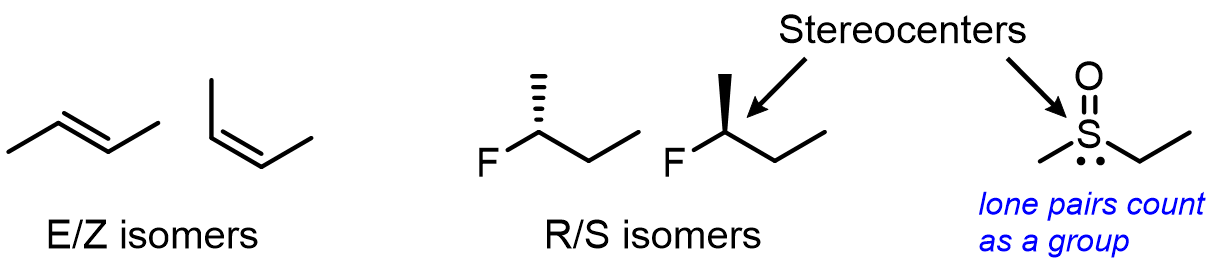
Even though every atom is bonded the same way in two stereoisomers, the only way to interconvert them is to break a bond and re-form it with different geometry. That's what makes stereoisomerism permanent rather than conformational.
Enantiomers, diastereomers, and meso compounds
Two stereoisomers in front of me — how do I name their relationship?
Two stereoisomers that are mirror images are enantiomers; two that are not mirror images are diastereomers; and a molecule with stereocenters that is nevertheless achiral is a meso compound.

Live examples of enantiomer pairs load as you scroll here…

Live examples of diastereomer pairs load as you scroll here…
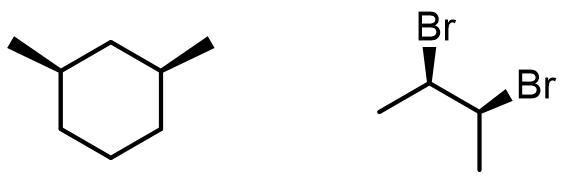
Live examples of meso compounds load as you scroll here…
Chirality: the mirror-image test
How do I decide whether a molecule is chiral?
A molecule is chiral if it cannot be superimposed on its own mirror image. Chirality is a property of whole objects — hands, screws, and molecules alike.
The relationships above beg a question: why are enantiomers different compounds, while a meso compound and its mirror image are the same one? The answer is chirality — whether an object differs from its own mirror image.
Here is the test itself, first on a carbon with four different groups and then on one with two the same:
With four different groups on the carbon, no turn superimposes the mirror image on the original: the molecule is chiral, and the two drawings are different compounds with identical connectivity. With two groups the same, a half turn does it, so bromochloromethane is achiral.
A practical shortcut: achiral molecules have an internal mirror plane of symmetry — exactly what makes meso compounds achiral despite their stereocenters.

Hunt for one yourself. Turn A until the mirror cuts it into two halves that are reflections of each other; the right-hand panel shows the half on the left of the mirror together with its reflection, and when that rebuilds A you have found an internal mirror plane. The two dibromobutanes show why the search has to cover conformations.
CIP priority rules
How do I rank substituents by CIP priority?
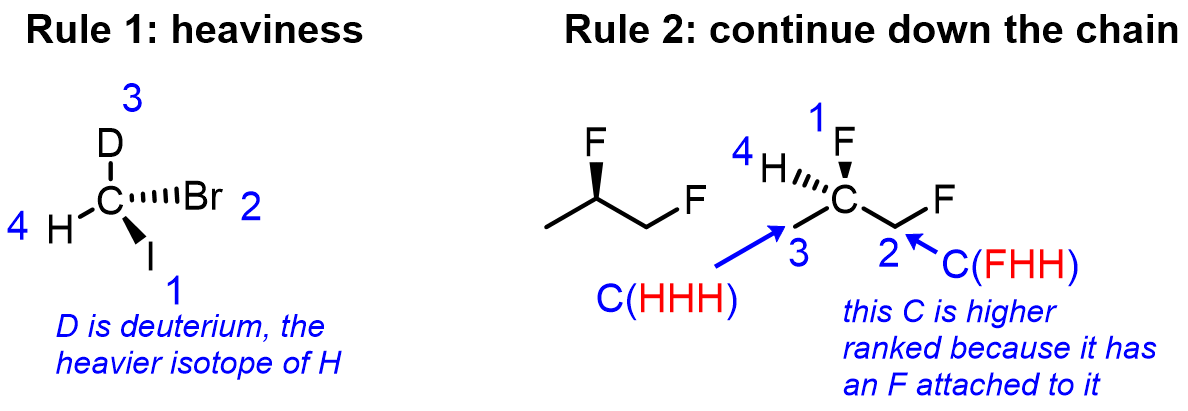
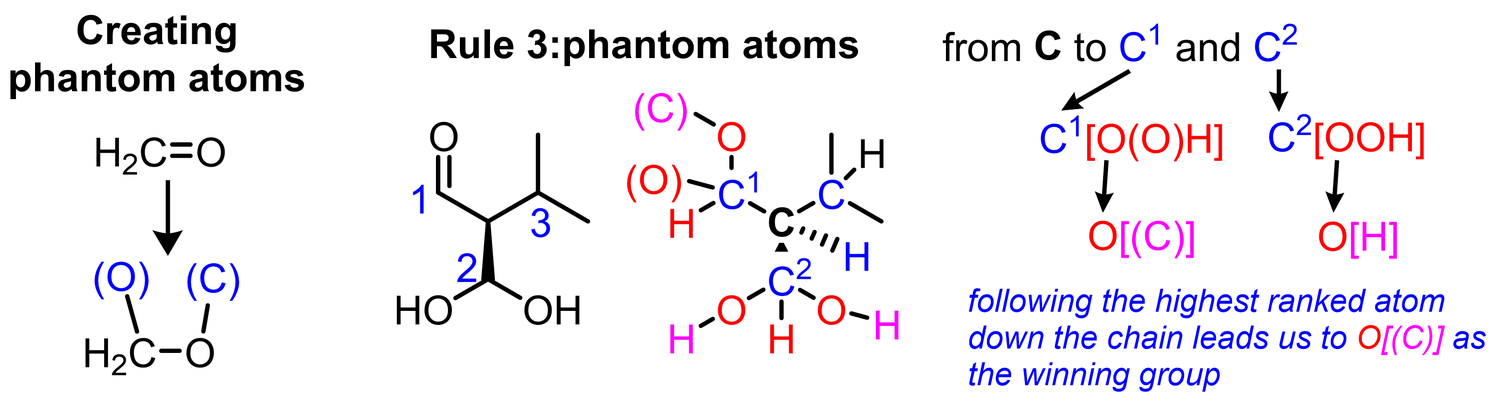
Stereochemical labels (R/S, E/Z) are assigned with the Cahn–Ingold–Prelog rules: rank the atoms attached to the stereocenter by atomic weight, break ties by walking down the chain through the highest-ranked atoms, and split multiple bonds into phantom atoms.
Assigning R and S
How do I assign R or S from a drawing?
Prioritize the four substituents, look at the stereocenter with priority 4 pointing away from you, and read 1→2→3: clockwise is R, counterclockwise is S.
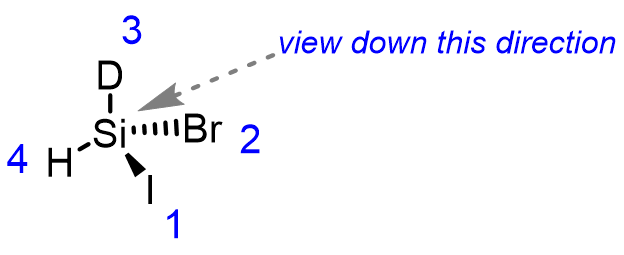
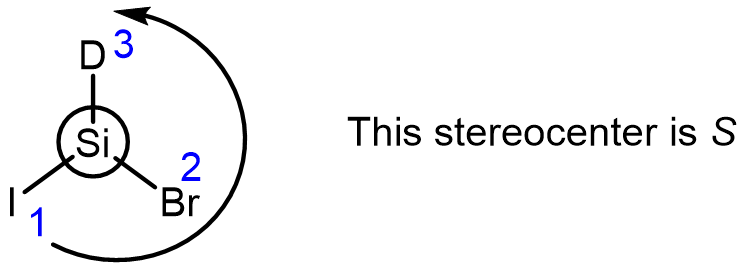
Live examples load as you scroll here… or jump straight to R/S practice.
Try this
- Here is a live stereocenter from our problem bank. Before touching anything, find the four different substituents and rank them 1–4 in your head.
- Click Walk through and step to the end. The priorities are assigned one layer at a time — notice how each tie is broken by comparing atoms one bond further out — and the final frame is the full answer key. Check it against your ranking.
- Advance to the next example (›) and rank the substituents on your own. Walk through again whenever you want to check yourself.
- Click Try one yourself and commit to R or S. The colored key appears after you answer, so you can audit your own reasoning.
Assigning E and Z
How do I assign E or Z on a double bond?
If each alkene carbon has two different substituents, rank them by CIP priority. Higher priorities on the same side of the double bond: Z (cis). Opposite sides: E (trans).

Live examples load as you scroll here… or jump straight to E/Z practice.
Beyond R and S: the lowercase descriptors r and s
Why do some stereocenters get lowercase r/s?
A pseudoasymmetric center carries two substituents with identical connectivity but opposite configuration — an R arm and an S arm. It is assigned the lowercase descriptors r and s, which, unlike R and S, do not flip when the molecule is reflected.
Consider pentane-2,3,4-triol with C2 assigned R and C4 assigned S. The two arms attached to C3 contain the same atoms connected in the same order, yet they are not interchangeable: one is the (R)-arm and the other the (S)-arm. C3 therefore holds four distinguishable groups (H, OH, and the two arms) and is a real stereocenter — but exchanging its H and OH converts one achiral diastereomer into another, not a molecule into its enantiomer. The ordinary CIP rules can't rank the two arms, so an auxiliary rule breaks the tie (an R-configured branch ranks above S) and the resulting descriptor is written lowercase: r or s.
The lowercase letter is a flag with a precise meaning: reflection converts every R center to S, but r stays r and s stays s. That mirror-invariance is why pseudoasymmetric centers turn up inside meso and other achiral molecules — among the achiral isomers of cyclohexane-1,2,3,4,5,6-hexol (the inositol family), there is one whose six centers are all labeled r.
You will not need lowercase descriptors in a typical sophomore course — textbooks rarely mention them. But real compound names carry them, and our Isomer Relationships game draws from real PubChem structures, so you may occasionally meet one. Now you know what it means — and that it is telling you the center survives a mirror image unchanged.
Put it together: what's the relationship?
Two molecules, one formula — can I classify the relationship?
Given two molecules with one formula, work the decision tree: different connectivity → structural isomers. Same connectivity → compare configurations: all inverted → enantiomers; some inverted → diastereomers (E/Z pairs included); none → identical — and watch for meso mirror images.
Every category from this page in one deck. Browse examples by type, or try classifying them yourself — and when you're warmed up, the Isomer Relationships game keeps score.
Live examples load as you scroll here… or jump straight to isomer relationship practice.
Optical activity
Does (+)/(−) rotation follow from R/S?
Enantiomers rotate plane-polarized light in opposite directions, labeled (+) and (−). This is measured, not derived: + and − have no correlation with R and S.
Optical rotation is how stereoisomerism is observed at the bench: one enantiomer of a chiral compound rotates linearly polarized light clockwise (+), the other counterclockwise (−). It's a useful experimental gauge, but the direction cannot be predicted from the R/S label — a classic exam trap.
Live examples load as you scroll here… or jump straight to meso practice.
More Practice for this Topic
Stereochemistry is a skill, not a fact list. We have four interactive problem sets for it:
- Assign R or S — with an interactive 3D model and a CIP walkthrough for every answer
- Assign E or Z — alkene configuration using CIP priorities
- Identify meso Compounds — find the internal mirror plane
- Stereoisomer Relationships — enantiomers, diastereomers, or identical?
Spotted an error, or want a topic covered next? Let us know.