Review: Periodic Trends
This guide is an early version — the text is complete, and a few figures are still being redrawn. Spotted something unclear? Let us know.
The question this page answers: How are periodic trends of elements/atoms relevant in molecules?
Electronic structure
Why care about electronic structure?
In addition to physical structures and geometries of molecules, organic chemists are interested in their electronic structure because it can explain and predict how molecules react with each other.
Under different models, the concept of electronic structure appears in two different ways:
- In VBT, electronic structure is thought of Coulombically—which parts of the molecule are partially or formally positive/negative in charge?
- In MO theory, electronic structure refers to the energy levels of the various MOs, and also where in 3D space these MOs are located around the molecule.
Electronegativity in the VBT model
What drives electronegativity trends?
In the VBT model, the electronegativity of elements is important for understanding how charge distributes in a molecule.
There are two electronegativity trends that derive from the effective nuclear charge (Zeff), which is the charge “felt” by valence electrons after accounting for shielding by core electrons.
- Going left-to-right across the periodic table, elements are more electronegative because Zeff increases across a row.
- Going down the periodic table, elements are less electronegative because the radius of the valence orbitals increases, which is a bigger factor than any increase in Zeff.
Organic chemists use electronegativity on a relative scale, with fluorine being the most electronegative. Here is an excerpt of the periodic table with electronegativity values:
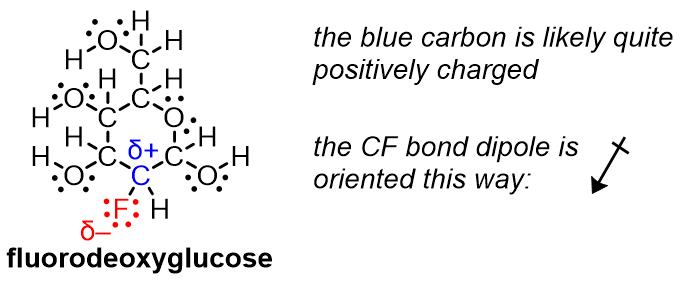
In molecules, organic chemists make quick judgments based on the electronegativity of the atoms involved. Here is an example with fluorodeoxyglucose, which is an important radiotracer used in medical imaging:
Organic chemists will also compare the stability of different resonance forms using this information because the overall resonance hybrid of a molecule can be modeled by taking an average of resonance forms weighted by how stable they are. You will learn more about this later. Here is an example:

Electronegativity in MO theory
How does electronegativity affect MOs?
In MO theory, electronegativity skews the shape of MOs and their energy levels, which correlate to how “positive” or “negative” the atoms might be in a VBT model.
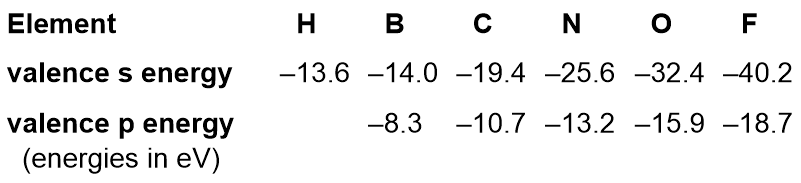
The more electronegative the element, the lower in energy its orbitals are, as shown in this table comparing experimentally measured valence orbital energies for the most organic chemistry-relevant elements:
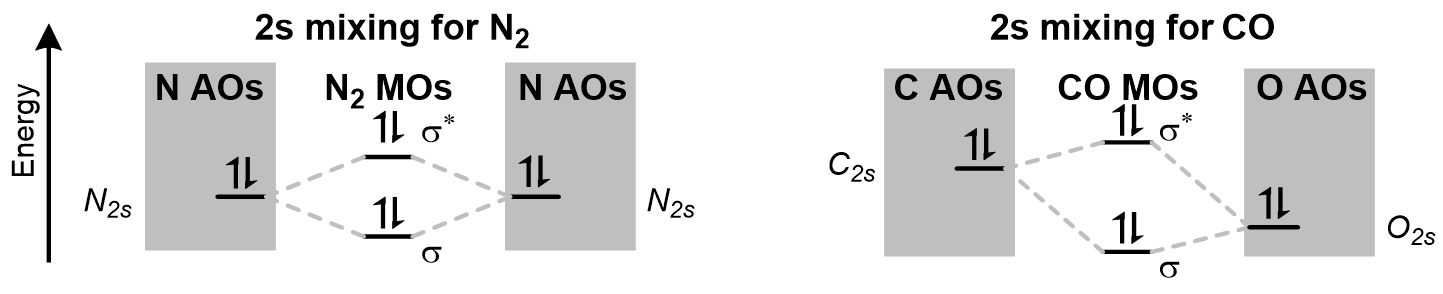
The energy of MOs that are created by mixing AOs depends on the energy of those AOs. The result is that the σCO MO is lower in energy than σNN, and σ*CO is higher in energy than σ*NN.
This model works remarkably well. From the visual side of things, it turns out that when summing up atomic of unequal energies, the resulting MO will localize more on the atom it is closer in energy with. Here is a comparison of the π and π* MOs for N2 vs. CO:
For these molecules, the π bonding orbital is occupied with two electrons, while the π* is anti-bonding and unoccupied. These happen to be the highest occupied MO (HOMO) and lowest unoccupied MO (LUMO), respectively. Based on the visualization above, you can see that the LUMO of CO is largely on the carbon atom. This extrapolates surprisingly well to molecules—you will see in the future that the reactivity of C=O π bonds can be approximated by using the CO molecule’s π and π* MOs.
VBT vs. MO explanations
Which model predicts better?
For many organic chemistry experimental observations, it is possible to use either VBT or MO theory to explain what is happening, but MO theory will get more predictions correct than a VBT mindset.
For example, here is an acid-base reaction that forms acetic acid, which is ~5% of vinegar:
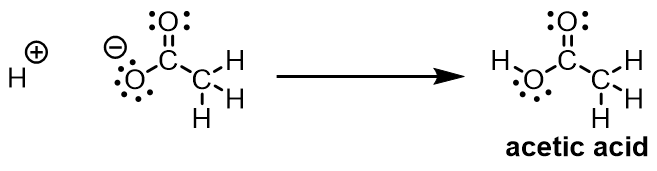
- The VBT/Coulombic explanation is that an atom with formal/partial negative charge (O–) reacts with a formally/partially positive atom (H+) to form a new O–H bond.
- The MO explanation is that the HOMO of one molecule (the electron pair in the π MO of the allyl system) reacts/mixes with the LUMO of the other (the empty H1s orbital that receives the pair of electrons) to form the new O–H σ bond.
Atomic radius
Why does atom size matter?
Another important periodic trend is atomic radius because the size of the atom impacts the strength and length of bonds the atom forms.
There are two rough trends:
- Atomic radius decreases going left-to-right across a row in the periodic table, mostly because Zeff increases.
- Atomic radius increases going top-to-bottom in a column because the increase in principal quantum number leads to with greater volume (and thus larger radii).
The size of atoms has two important impacts:
- Larger atoms will locate themselves further from other atoms, which we can model as a consequence of electron repulsion. You will learn about this more in the future, but for now here is an example:

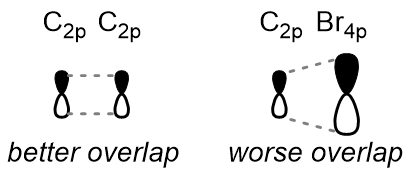
- From a MO perspective, bonds between atoms of significantly different atomic radii are often weaker, which is modeled by the idea that there is poor mixing between size mismatched AOs. Here is a visual representation:
Polarizability
Why does polarizability matter?
Finally, polarizability of the elements is significant because:
- it impacts the relative stability of + or – charge on an atom or molecule, thus affecting reactivity.
- It increases attraction between molecules/atoms
Polarizability refers to the tendency of electrons to generate temporary induced dipoles when exposed to an external electric field. In general, polarizability increases when:
- The atomic radius increases.
- The number of electrons increases.
An interesting nuance is that inherent polarity and polarizability are not the same. For example:
- H2O is a very polar molecule, but CH4 is a more polarizable molecule because C is less electronegative than O;
- C–Cl is a polar bond, but C–I is more polarizable; C–I bonds turn out to be more reactive than C–Cl bonds because C–I is “easier to polarize to the point of breaking”.
Spotted an error, or want a topic covered next? Let us know.