Review: Lewis Structures
This guide is an early version — the text is complete, and a few figures are still being redrawn. Spotted something unclear? Let us know.
The question this page answers: How do you draw and read Lewis structures?
What Lewis structures show
Nuclei and valence electrons only
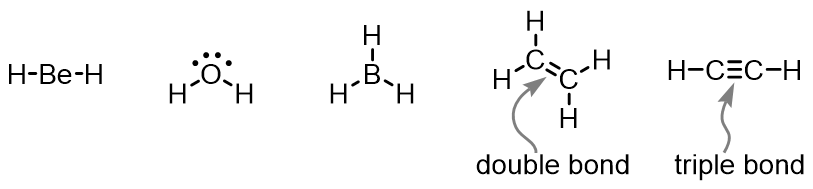
Lewis structures are drawings that show the atomic nuclei and valence electrons in a molecule, and ignore the core electrons.
Lewis structures give chemists a quick way of drawing molecules that shows bonding between atoms and the presence of any unbonded electrons. Bonds are shown as lines (one per pair of electrons). Here are some examples:
Formal charge
Why does formal charge matter?
It is important to be able to recognize formal charge states of atoms in Lewis structure drawings because reactions often involve the formation of formally charged species.
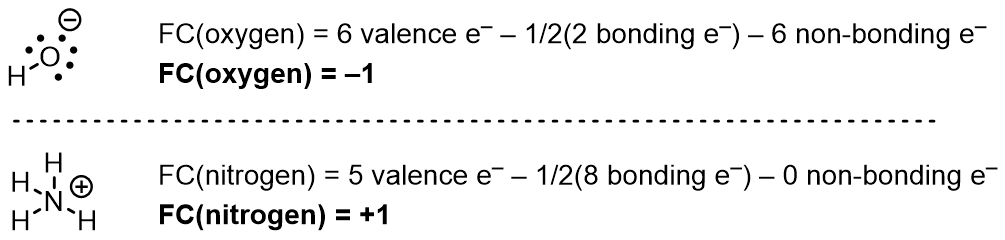
The formal charge (FC) of an atom in a Lewis structure is calculated using the following formula:
Here are some examples:
Formal charge is not necessarily real
Where does the charge really sit?
An important caveat is that formal charge of an atom of a drawing is not necessarily real.
Although the total formal charge of a molecule is correct, the exact location of formal charge within a molecule sometimes differs from how it appears in the Lewis Structure drawing. For example, in the NH4+ cation below, more sophisticated molecular modeling shows that the H atoms are positively charged, not the N. Here is a computational model of the electrostatic charge around NH4+:
Resonance forms and the resonance hybrid
Which form really exists?
Another limitation of Lewis Structures is that they do not capture π electron delocalization very well, so we need to rely on the concept of a single molecule being represented by multiple significant resonance forms.
Even though you might draw multiple resonance forms for a given molecule, in real life the molecule only exists as a single entity, which is called the resonance hybrid. Conceptually, the resonance hybrid looks pretty similar to the weighted average of all the possible resonance forms. Here is an example for the molecule benzene:

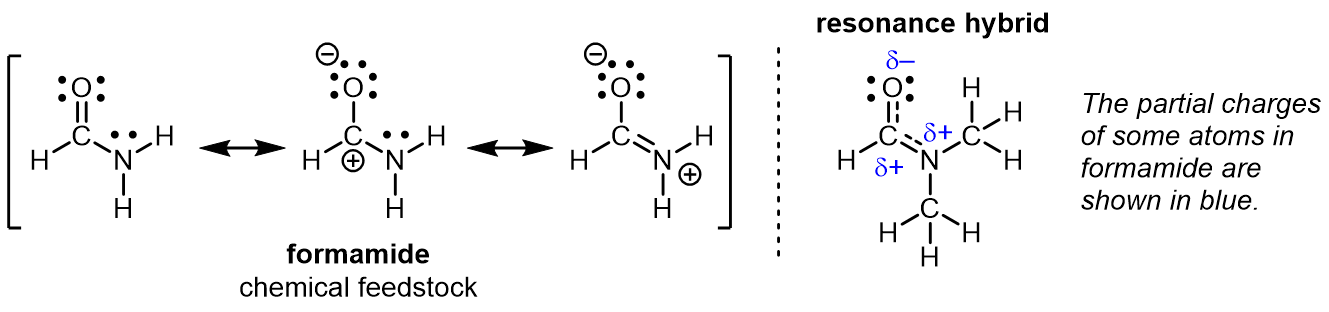
In cases where the resonance forms are not degenerate, their relative importance will be reflected in molecule as well. This concept is used in organic chemistry very qualitatively to answer questions about where a molecule is partially positively or negatively charged. Here is an example for the molecule formamide:
There are two important considerations about resonance to keep in mind for organic chemistry:
- A very common misconception is that electrons in a molecule alternate between resonance forms, when in reality only the resonance hybrid exists.
- In general chemistry, you likely learned to draw resonance forms by adding electrons in different ways to a given “skeletal” structure. Organic chemists instead begin with a Lewis structure drawing and conceptualize its conversion into other resonance forms. You will learn how to do this quickly in the future.
Spotted an error, or want a topic covered next? Let us know.