Review: Chemical Reactions
This guide is an early version — the text is complete, and a few figures are still being redrawn. Spotted something unclear? Let us know.
The question this page answers: What features of chemical reactions are important?
Reactants, transition states, and products
What three energy levels matter?
In chemical reactions, reactants bump into each other by chance, absorb energy to rearrange their nuclei and electrons, and thus create products through bond-breaking and bond-making.
When thinking about reactions, organic chemists consider three energy levels:
- reactant energies
- transition state energies
- product energies
For example, in the reaction between H2O and NH3 shown below, the transition state of the reaction is the point where the two molecules bump into each other in a way that half-breaks the O–H bond and half-makes the new N–H bond.

The transition state is higher in energy than either the reactants or the products because a bond is being broken (causing the system to be less stable), and a new bond hasn’t been fully made (meaning the system energy hasn’t benefited from new bond formation yet).
Thermodynamics and kinetics
How favorable vs. how fast
There are two important aspects to all reactions:
- Thermodynamics dictate how favorable a reaction is.
- Kinetics dictate the rate of the reaction, in other words, how fast it goes.
These aspects of a reaction can be seen in a reaction coordinate diagram, such as the hypothetical one below for the reaction between H2O and NH3.
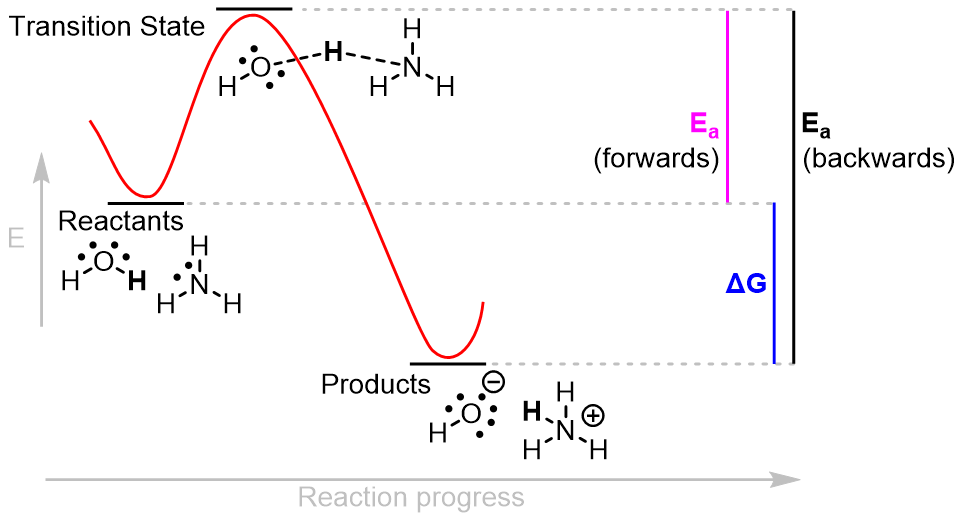
A reaction is favorable, in other words more likely to yield products than reactants, if the change in Gibbs Free Energy (ΔG) going from reactants to products is negative in value. This is the case in the reaction coordinate diagram above. In other words, the products are lower in energy and more stable than the reactants, and Gproducts – Greactants < 0.
The rate of a reaction is determined by how big of an energy hill there is between the reactants and the products in the reaction coordinate diagram. The size of the hill is the activation energy (Ea) or reaction barrier.
Thermodynamic equilibrium and Keq
When does a reaction reach equilibrium?
Given infinite time, all chemical reactions can theoretically reach a thermodynamic equilibrium, which is the point at which the rate of the forward reaction is the same as the rate of the backward reaction.
When a reaction is at equilibrium, the ratio of products to reactants is a value called the equilibrium constant Keq:
Keq is also related to the energy difference between reactants and products:
Although all reactions are technically equilibria, many chemical reactions appear to be one-way processes. This is usually the case when ΔG is relatively large. This difference is indicated using a reaction arrow as opposed to an equilibrium arrow.

In the lab, organic chemists will often use Le Chatelier’s Principle to their advantage by using a molar excess of one reactant, or removing the product, to “drive a reaction to completion”. In other words, convert as high a percentage of reactants into products as possible.
Spotted an error, or want a topic covered next? Let us know.