Review: Modeling Atoms and Molecules
This guide is an early version — the text is complete, and a few figures are still being redrawn. Spotted something unclear? Let us know.
The question this page answers: What different models of atoms and molecules will you use to understand organic chemistry?
The Schrödinger equation
Why start with the Schrödinger equation?
The Schrödinger Equation is a fundamental equation of quantum mechanics that helps us understand particles such as electrons, and thus is essentially the basis of all of chemistry:
There are three components to the Schrödinger Equation:
- is an energy value
- is a function that assigns a value to points in 3D space.
- is called the Hamiltonian. It is used to solve for functions that fit the equation.
Chemists care about energy because systems undergo chemistry in a way that lowers energy, and we care about the function because it helps us to understand .
The function is also known as a wavefunction, or an orbital. Again, the three terms , wavefunction, and orbital all mean the same thing in the context of chemistry.
The Schrödinger Equation can only be exactly solved for a small number of situations.
One case where the Schrödinger Equation can be solved is for a neutral H atom. It turns out that there are many functions as possible solutions, each with an associated energy value. Here is the that corresponds to the lowest (most stable) value of :
This complicated looking function is what you know as a 1s orbital. At each point in 3D space, has a value that is related to the probability of finding a particle of energy at that location. For chemists, the particle is an electron. Plotting in 3D gives us a visual of what we mean when we talk about the 1s orbital:
The many solutions to the Schrödinger Equation can be categorized by their shapes.
Organic chemists primarily think about atomic , or orbitals, that are either spherical (s orbitals) or shaped like the number 8 (p orbitals):
From atoms to molecules
Why do atoms bond at all?
Most atoms do not remain isolated in nature, and instead combine into what we call molecules.
Molecules consist of atoms that are bonded or arranged together in a way that, in most cases, reduces the energy of the system compared to leaving the atoms unbonded. For example, placing two neutral H atoms near each other results in the formation of the molecule H2:

Unfortunately, for almost all molecules it is impossible to determine exact solutions of for the Schrödinger Equation of the molecule.
Fortunately, adding ’s of the H atoms together actually gives a pretty good approximation of ’s for the H2 molecule. This approximation even works when using visualizations of :
In other words, we can approximate the mathematical solution to the Schrödinger Equation of a molecule by using a visual approach. There is an important nuance here: orbitals do not decide to overlap/mix to form bonds. We humans pretend that orbitals mix because doing so happens to approximate the adding up of functions. Additionally, orbitals are just mathematical functions that electrons may or may not exist in.
Since organic molecules tend to comprise of many atoms and electrons, organic chemists need fast, non-mathematical ways of approximating solutions for molecules.
These are the three main models/theories that organic chemists use to make these quick, relatively good approximations:
- Molecular Orbital Theory
- Valence Shell Electron-Pair Repulsion Theory
- Valence Bond Theory with Hybrid Atomic Orbitals
Molecular orbital (MO) theory
How do you build an MO?
In molecular orbital (MO) theory, all of the atomic (the atomic orbitals, or AOs) in a molecule are added together to create new , called molecular orbitals.
Much like atomic orbitals, molecular orbitals are an approximation of where in 3D space an electron of a particular energy is likely to be found around the nuclei of the molecule. Here are visual examples of a few of the many MOs for the molecule benzene:
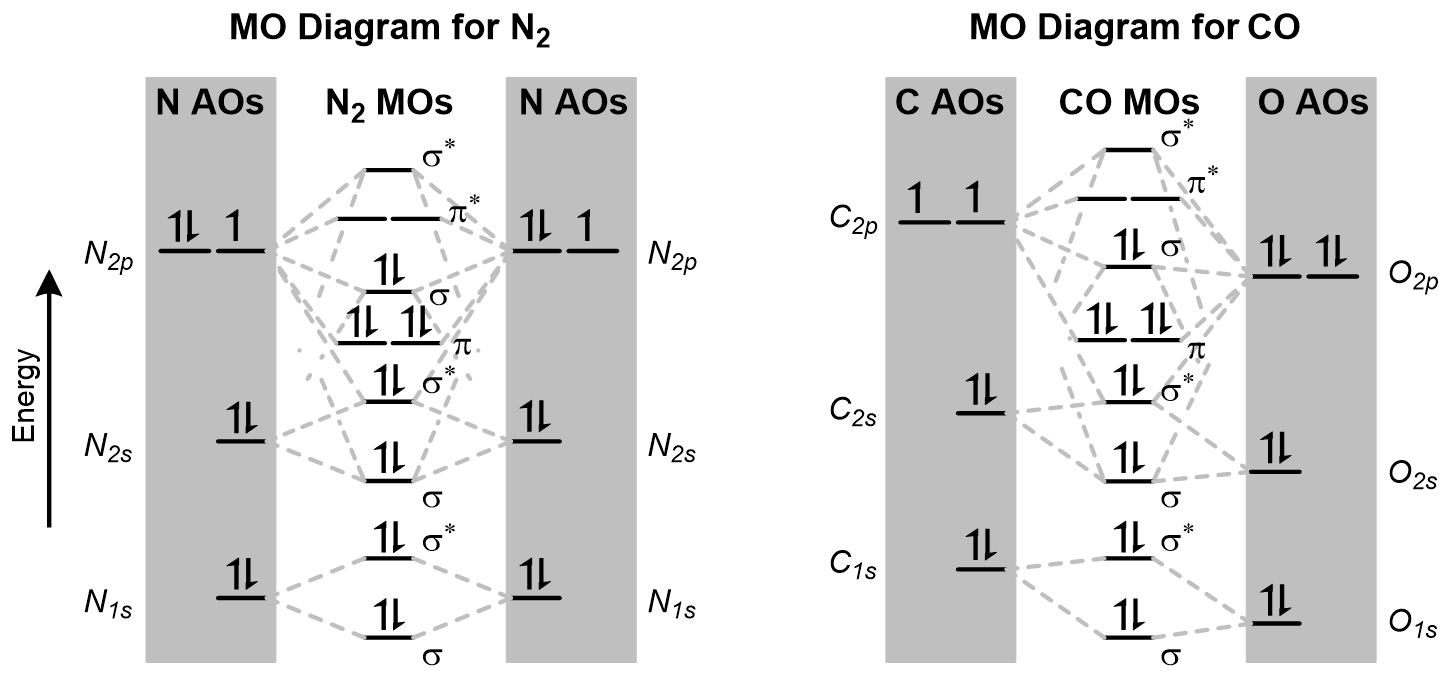
Computational power is required to make good approximations of reality for most molecules, in general chemistry. In the past, however, you have likely learned how to approximate MO diagrams for diatomic molecules by mixing two atomic orbitals to help imagine the approximations of two MOs, one of which is bonding and the other is anti-bonding. For reasons beyond us, this is always the case—summing up two will lead to two new ’s, one of which is stabilized (bonding) and one of which is destabilized (anti-bonding*) compared to the original . You can see this in action in the diatomic MO diagrams here:
VSEPR theory
How do electron groups arrange?
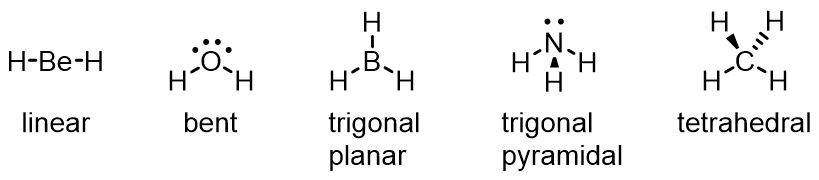
Valence shell electron-pair repulsion (VSEPR) theory, states that electron pairs/groups around an atom maximize distance between each other.
VSEPR theory was developed from experimental observations of bond angles in molecules. Here are some VSEPR geometries relevant to organic chemists:
Valence bond theory with hybrid atomic orbitals
Two simplifications, then hybridization
- In valence bond theory (VBT), two simplifications are made compared to MO theory:
- instead of all atomic , VBT only adds up valence-level atomic to create valence MOs.
- instead of adding up all atomic simultaneously, VBT pretends each bond is an independent diatomic molecule resulting from pairs of atomic being summed.
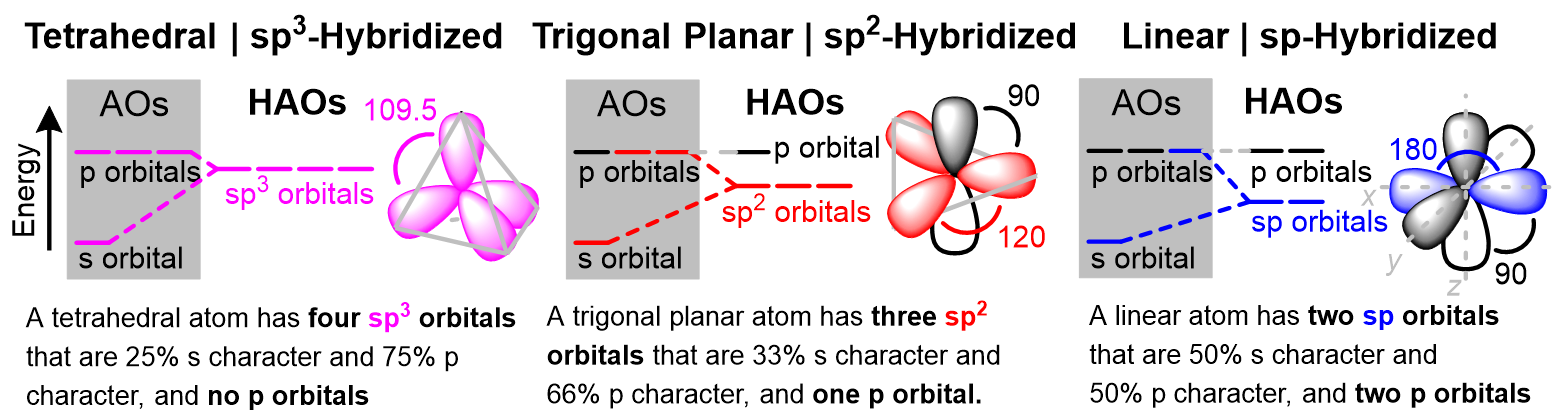
Pure VBT actually fails to provide good approximations. For example, VBT predicts the molecule H2O to have OH bonds at 90° angles because the oxygen 2p orbitals are orthogonal to each other, while VSEPR and MO theory correctly predict the bond angle to be ~120°. To solve this problem, we invent hybrid atomic orbitals (HAOs) by averaging the number of valence atomic orbitals needed to achieve VSEPR geometries. For H2O, there are four electron groups around the O atom, so one 2s and three 2p orbitals are hypothetically hybridized to create four sp3 hybrid atomic orbitals (magenta below) that have an energy in between those of 2s and 2p. This concept is shown here for sp3, sp2, and sp hybridization:
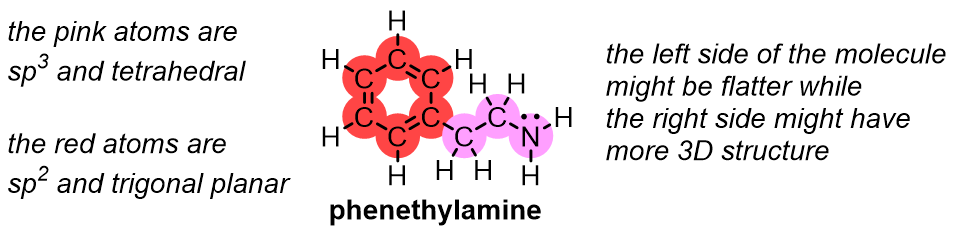
VBT, hybridization, and VSEPR are most useful for an initial approximation of the geometry and structure of a molecule.
Here is an example for the central nervous system stimulant phenethylamine:
Hückel theory and delocalization
How do you spot delocalization?
Simplified, qualitative versions of MO theory such as Hückel Theory are useful for understanding π bonds, particularly when they are delocalized beyond more than two atoms.
Delocalization, or sharing of electrons, typically stabilizes a system. For example, you can think of the electrons in H2 as being delocalized around two nuclei because that is more stable than having two isolated H atoms. It turns out that in good models, π bonds and lone pairs in molecules are often delocalized over more than two atoms, and VBT is unable to approximate these delocalized π bonds adequately. Therefore, organic chemists use Hückel Theory, which is a simplified and qualitative version of MO theory. Instead of summing just two like in VBT, or all like in MO theory, Hückel Theory sums the involved in delocalization (these are almost always adjacent p orbitals).
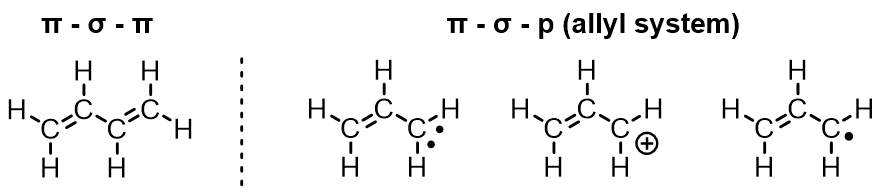
This idea may sound foreign, but you almost certainly have already learned this concept in general chemistry through resonance or conjugation. Resonance, conjugation, and delocalization are all words for describing situations where π electrons are best approximated as being shared between more than two atoms. You will spend significant time learning more about resonance in organic chemistry. For now, what is important is that you can identify where there might be delocalization in a molecule, using these two bonding patterns:
- π bond – σ bond – π bond
- π bond – σ bond – p orbital, also known as an allyl system
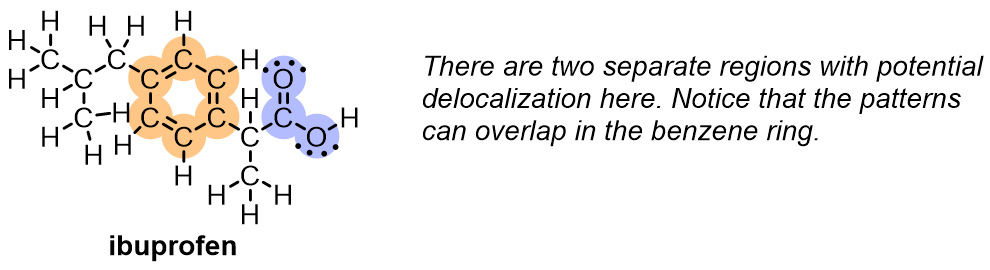
Here is an example of how an organic chemist would think about delocalization in a molecule of ibuprofen, a common pain killer:
Degeneracy
Orbitals with the exact same energy
Degeneracy refers to orbitals with the exact same energy.
Many molecules have degenerate MOs. Something to be careful about is that Lewis Structures and VBT will imply that there is more degeneracy then there actually is. Here is an example for benzene:
That all being said, it is important to see that the Lewis Structure and VBT do correctly capture the concept of having π electrons in benzene delocalized across all 6 carbon atoms, and so you will often hear organic chemistry instructors talk about how the 3 π bonds are equally capable of participating in a chemical reaction.
Spotted an error, or want a topic covered next? Let us know.