Review: Acid-Base Reactions
This guide is an early version — the text is complete, and a few figures are still being redrawn. Spotted something unclear? Let us know.
The question this page answers: Why does acid-base chemistry matter in organic chemistry?
Two types of acid-base reactions
Which two types matter most?
There are two types of acid-based reactions that are most relevant to organic chemists:
- Brønsted-Lowry acid-base reactions
- Lewis acid- base reactions
Organic chemists care about acid-base reactions—Brønsted-Lowry acid-base reactions in particular—because:
- Trends in acid and base strengths are correlated to trends in reactivity of organic molecules more broadly.
- Many organic reactions involve acid-base reactions as part of their overall processes.
Brønsted-Lowry acid-base reactions
What gets transferred?
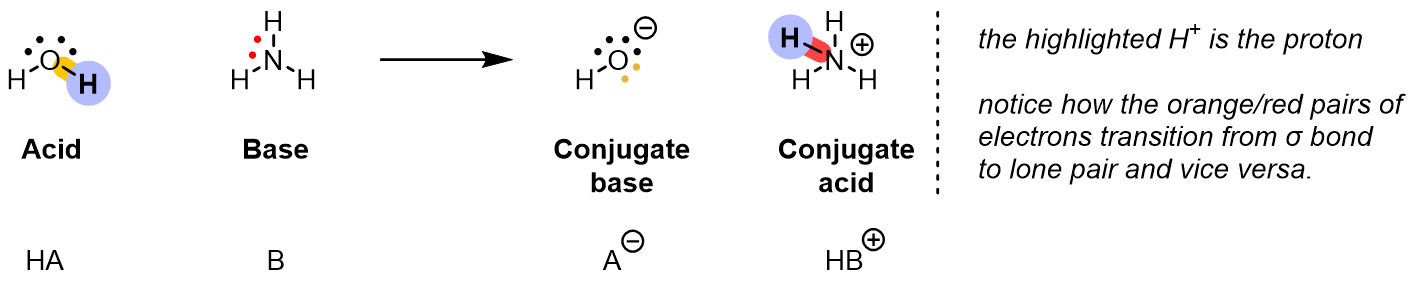
In Brønsted-Lowry acid-base reactions, an acid and base react by exchanging a proton (H+) from the acid to the base to form a conjugate base and conjugate acid, respectively.
Here is an example of a Brønsted-Lowry acid-base reaction between H2O and NH3:
pKa as the measure of acidity
Lower pKa, stronger acid
Often, pH is discussed as a measure of the acidity of an aqueous solution. Organic chemists, however, typically use solvents other than water, and thus they use a different measure of acidity, pKa of a molecule. The math behind pKa gets complicated, but here is what matters:
- Ka is the acid dissociation constant, or the extent to which a molecule HA will break apart into H+ and A–. The equation for Ka is shown here:
- Because experimentally measured Ka values cover a massive range, it is more convenient to think about acid strengths in orders of magnitude rather than in absolute values. Mathematically, this takes place as follows:
What organic chemists care about is being able to judge between two acids, which is stronger? There are two important scenarios:
- Given two potential Brønsted acids, which is stronger?
- In an acid-base reaction, which is stronger, the acid or the conjugate acid?
Here are trends in acidity that derive from the equations above:
- Strong acids are favored to react with bases, and thus strong acids exhibit larger Ka values in acid-base reactions.
- Consequently, strong acids have lower (more negative) pKa values.
- A difference of 1 pKa unit is an order of magnitude. Here is an example:
- pKa(HCl) = –7 pKa(acetic acid) = 5HCl is a 1012 times stronger acid!
Lewis acid-base reactions
Lone pair meets empty orbital
Lewis acid-base reactions are defined more broadly, and refer to any situation where a lone pair (Lewis base) interacts with an empty orbital (Lewis acid).
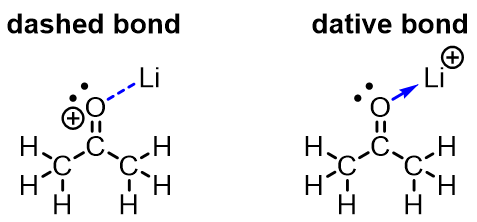
Commonly, a Lewis acid-base reaction is described as a reaction between an electron pair donor and an electron pair acceptor. For organic chemists, Lewis acid-base reactions most commonly refer to reactions between cationic metal ions and lone-pair containing organic molecules. Here is an example:

The reason that organic chemists care about Lewis acids is that they are used commonly to:
- Accentuate + charge in an organic molecule
- Stabilize a molecule through bond formation.
The bonds formed in Lewis acid-base reactions are conceptually different from other covalent bonds because both electrons in the new bond originate from only one atom, so chemists sometimes draw this using a dashed bond or an arrow, also known as a dative bond.
Spotted an error, or want a topic covered next? Let us know.