Delocalization and Resonance
This guide is an early version — the text is complete, and a few figures are still being redrawn. Spotted something unclear? Let us know.
The question this page answers: How do we approximate the sharing of electrons between more than two atoms 1) in our mind and 2) in line-angle drawings?
Deeper reading: Clayden 2e: Chapter 7 Page 141–156 — see our chapter-by-chapter practice map for Clayden.
Delocalization of π electrons
When do p orbitals conjugate?
A combination of valence bond and MO theory can be used to describe delocalization of π electrons through multiple atomic p orbitals that are conjugated together to form extended π-systems.
These p orbitals will only conjugate if they are aligned and parallel with each other.
Here are some experimental observations that tell us valence bond theory is insufficient:
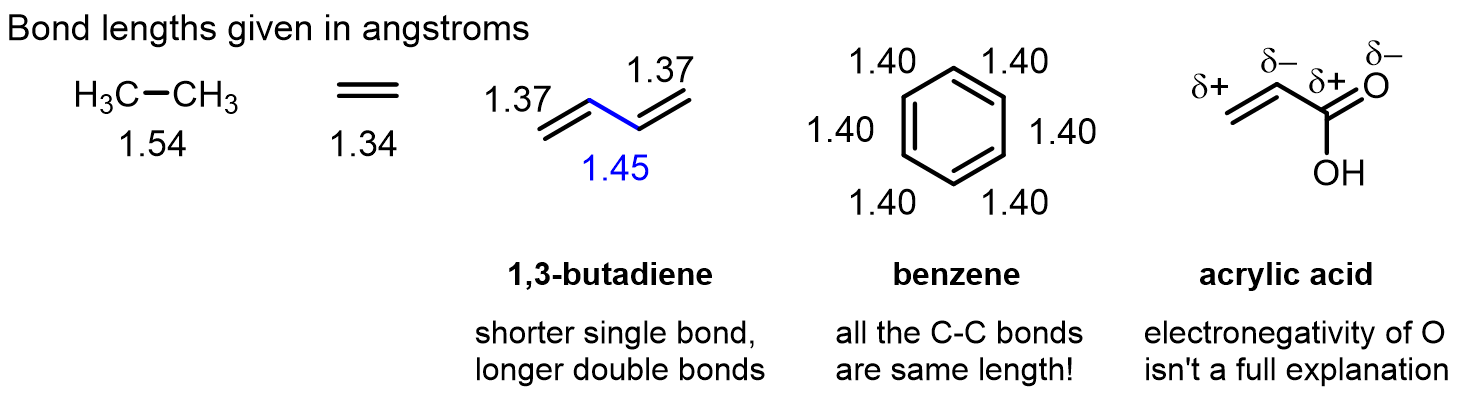
Simplified MO diagrams
What does the MO picture reveal?
To describe π delocalization, we draw simplified MO diagrams of only the valence p orbitals and electrons of the molecule. Here is an example for 1,3-butadiene, where there are four p orbitals and four electrons:
Notice how this MO diagram reveals there is π bonding between C2–C3 in the π1 MO that is not reflected in the line-angle drawing.
We can explain the observed bond lengths of 1,3-butadiene by saying that there is a reduction in double-bond character of C1–C2 and C3–C4 that is compensated by gaining electron delocalization through increased double-bond character of C2–C3.
The concept of resonance
Do molecules flip between forms?
To visually and mentally “see” this delocalization that is present in conjugated systems, we rely on the concept of resonance.
Resonance requires us to
- draw a few of the most reasonable Lewis structures for a given molecule (these are called resonance forms or resonance contributors)
- determine their relative importance to the molecule
- mix these resonance forms together in our mind, weighted by their relative importance, to create a resonance hybrid, which is the more accurate understanding of electron distribution.
It is crucial to remember that resonance forms are fictitious drawings that help us imagine the resonance hybrid. In other words, molecules do not exist as interchanging resonance forms, but rather exclusively as the resonance hybrid.
Here is how resonance would work for 1,3-butadiene:
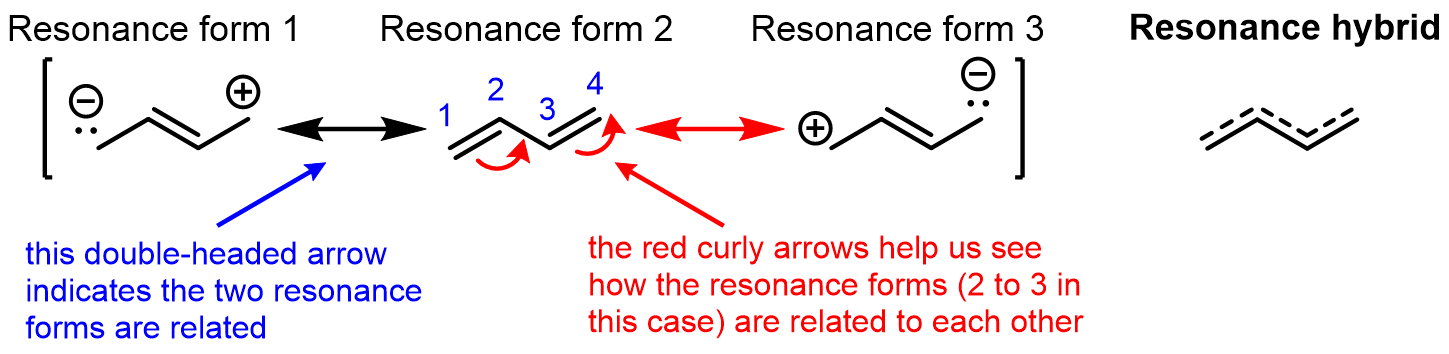
Thus, much like the MO picture above, Resonance form 1 and 3 tell us that C2–C3 has some double bond character in the resonance hybrid, and that C1–C2 and C3–C4 have a little less double bond character.
Common conjugation and resonance motifs
Which patterns show up frequently?
There are several conjugation and resonance motifs that show up frequently.
Here are the most common patterns:
- π bonds between atoms of different electronegativity

- π bonds separated by a single bond

- atom with lone pair adjacent to an empty atomic orbital
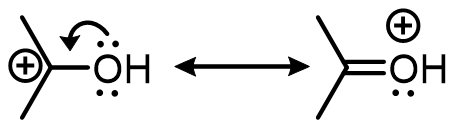
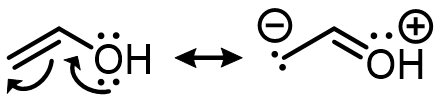
- “3-atom” delocalization where π bonds are conjugated to…
- a lone pair
- an empty orbital

- an unpaired electron

Relative importance of resonance forms
What makes one form more important?
The relative importance of resonance forms is determined by their relative stability. The most reasonable resonance forms will be the most stable Lewis structures.
Here is a general guideline of factors to consider, from most to least important, with the more important resonance forms depicted in red.
- Maximize the number of filled octets
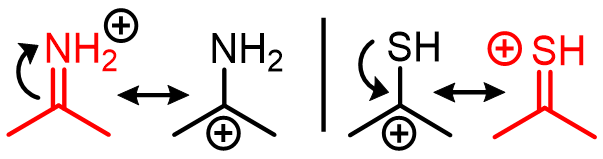
- Minimize the number of formal charges
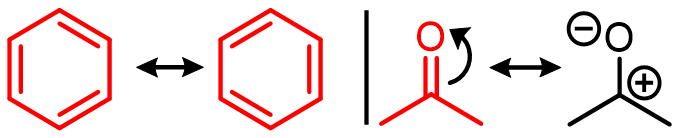
Stabilizing negative charges
Where do negative charges go?
- Stabilize negative charges by placing them…
- On more electronegative atoms
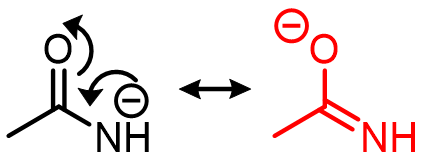
- On more polarizable atoms
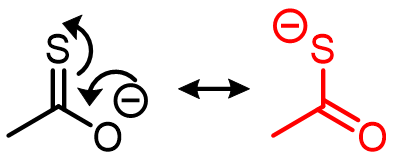
- Closer to electronegative atoms

- On atoms with more “s” character

Stabilizing positive charges
Where do positive charges go?
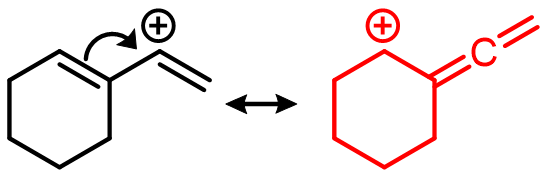
- Stabilize positive charges by placing them…
- On carbon atoms with more carbon substituents
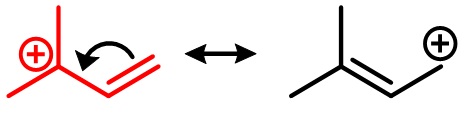
- Far from electronegative atoms

- On atoms with less “s” character
More Practice for this Topic
Deciding which form matters, and pushing the arrows that get you there, are separate skills. Here are both:
- Compare Resonance Contributors — pick the more significant contributor from a pair, and see which rule decided it
- Resonance Arrows — draw the curved arrows that convert one form into the next
- Identify Aromaticity — the ring systems whose stability the aromaticity rule above is about
Spotted an error, or want a topic covered next? Let us know.