Radical Reactions
This guide is an early version — the text is complete, and a few figures are still being redrawn. Spotted something unclear? Let us know.
The question this page answers: How do reactions involving free radicals work?
Deeper reading: Clayden 2e: Chapter 37 Pages 970–980, 984–998, 999–1002 — see our chapter-by-chapter practice map for Clayden.
Free radicals and their stability
What is a free radical?
Free radicals are molecules with an unpaired electron. Radicals are generally reactive species.
As with all molecules, there are two aspects of stability. Radicals are thermodynamically stabilized by conjugation and by alkyl substitution. Here are some trends:

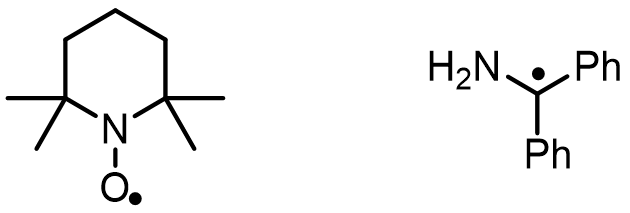
Persistent radicals are kinetically stabilized by sterics that prevent them from being able to react despite being thermodynamically unstable. Here are examples:
Homolytic bond cleavage and BDEs
How are radicals formed?
Radicals are formed by homolytic bond cleavage.
Bond dissociation energies (BDE) are a measure of how strong bonds are in terms of homolytic cleavage, in contrast to heterolytic cleavage seen in ionic reactions:

Here are some common BDEs in kcal:
C–H (99-105)C–C (88)C–Br (67)C–I (51)O–O (34)
Three mechanistic steps
Initiation, propagation, termination
Radical reactions involve three mechanistic steps:
- Initiation
- Propagation/Abstraction
- Termination
Initiation takes place by the homolysis of weak bonds by heat and/or light energy input. In reactions, initiators with weak bonds are often used to jumpstart the radical reaction. Peroxides and AIBN are common initiators:

Propagation/abstraction refers to the transfer of radicals between atoms/molecules:

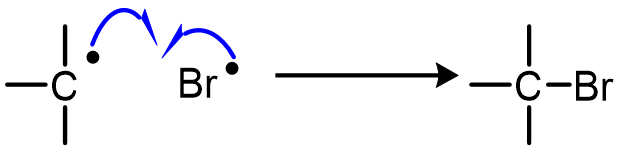
Termination occurs when two radicals pair up to form a bond:
Common uses of radical reactions
Halogenation, reduction, C–C bonds
Radical reactions are commonly used for:
- Halogenation
- Reduction of C–X to C–H
- C–C bond formation
Halogenation
Anti-Markovnikov HBr; allylic/benzylic NBS
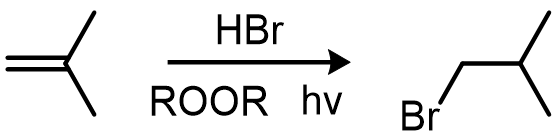
Under radical conditions, HBr adds in an anti-Markovnikov fashion to alkenes:
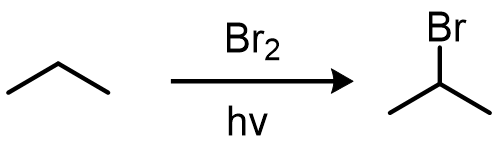
Alkanes can also be brominated:
More usefully, allylic and benzylic positions are easily halogenated, often using N-brominated reagents:

Reduction of C–X and C–C bond formation
Swap the halide for H or C
Halides can be substituted with hydrogens:
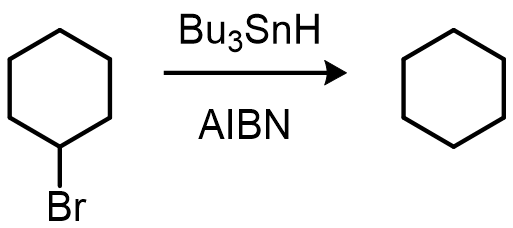
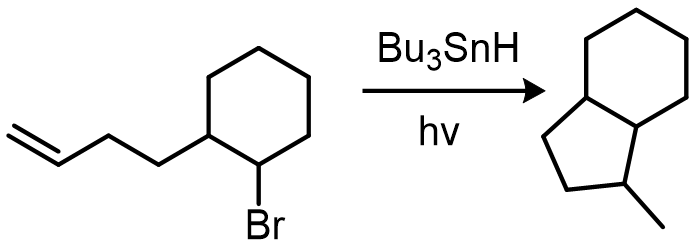
If there are alkenes present, then C–C bond forming reactions can be conducted:
Spotted an error, or want a topic covered next? Let us know.