Olefination with Stabilized Carbanion Nucleophiles
This guide is an early version — the text is complete, and a few figures are still being redrawn. Spotted something unclear? Let us know.
The question this page answers: How can we make alkenes from carbonyls?
Deeper reading: Clayden 2e: Chapter 27 Pages 664–667 and 689–693 — see our chapter-by-chapter practice map for Clayden.
What ylides are
What is an ylide?
Ylides are molecules with a resonance form containing adjacent atoms with opposite charges and full octets.
Experimentally, the ylide resonance form is found to contribute more to the hybrid than the less charge-separated ylene one:
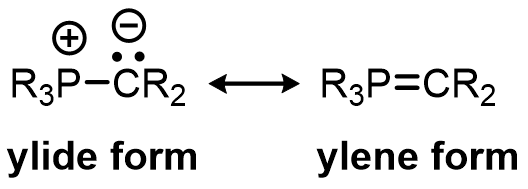
While phosphorus ylides are most common, there are many other analogous ylides:

Synthesizing ylides from onium salts
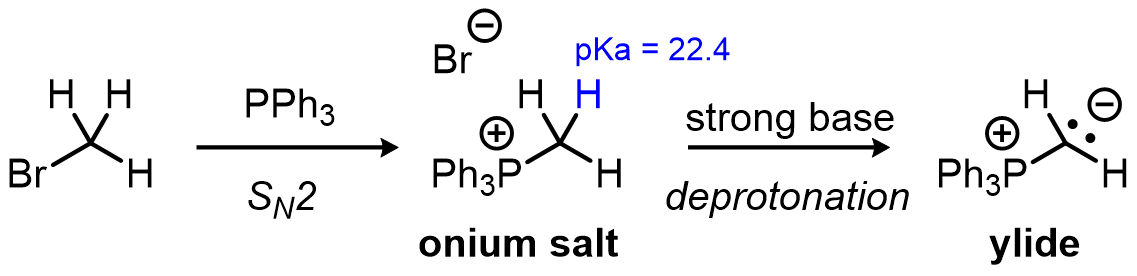
Deprotonate the onium salt
Ylides are typically synthesized by deprotonating the corresponding onium salt, which itself can be prepared by an SN2 reaction:
Several variations of olefination
Which name goes with which reagent?
Ylides are useful nucleophiles for converting ketones and aldehydes into alkenes. There are several variations:
- Wittig Olefination using phosphonium ylides
- Horner-Wadsworth-Emmons Olefination using stabilized phosphonate ester ylides
- Julia-Lythgoe Olefination using sulfones
- Julia-Kocienski Olefination using a heterocyclic sulfone
Wittig olefination
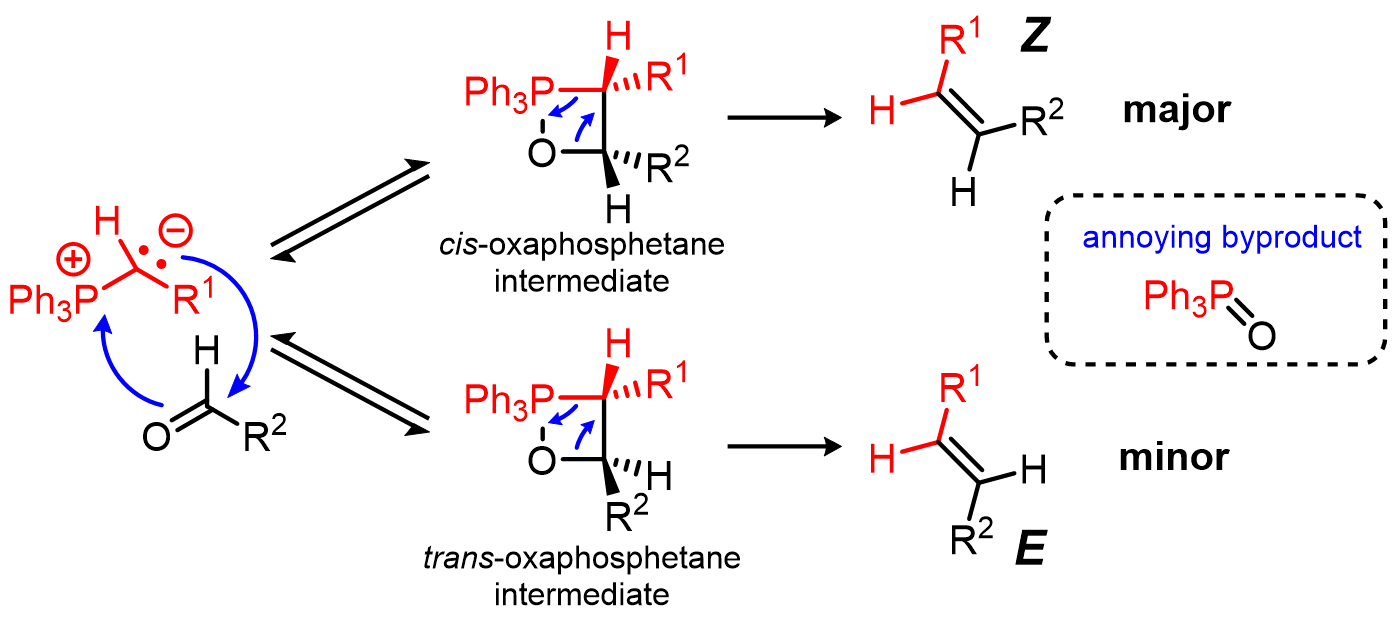
Phosphonium ylide → Z alkene
The Wittig Olefination favors the formation of Z alkenes. The reaction proceeds mechanistically through an oxaphosphetane intermediate:
Horner-Wadsworth-Emmons olefination
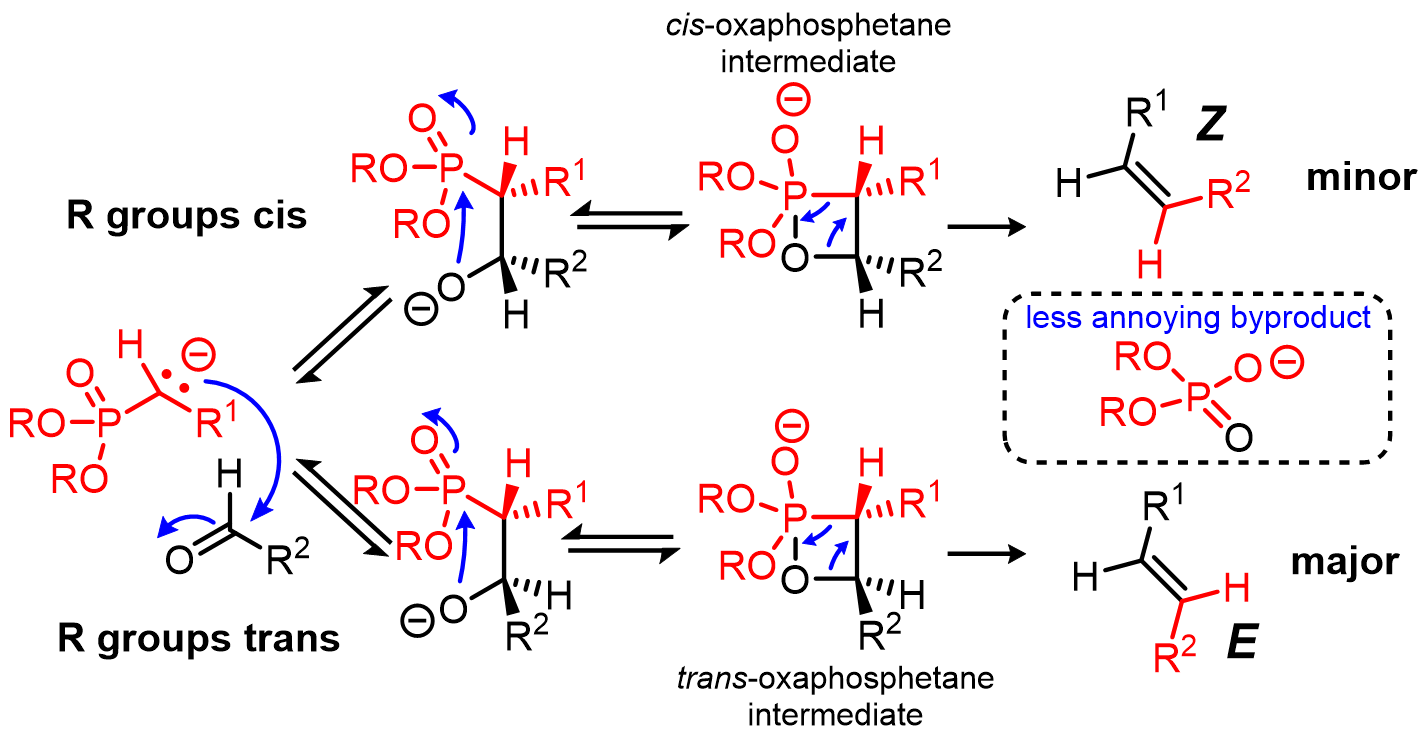
Phosphonate → E alkene
The Horner-Wadsworth-Emmons (HWE) Olefination uses a phosphonate instead of a phosphonium ylide and tends to favor the formation of E alkenes. The mechanism proceeds through two intermediates, first an alkoxide and then an oxaphosphetane:
Julia-Lythgoe and Julia-Kocienski olefinations
Sulfones → E alkenes
The Julia-Lythgoe Olefination uses a sulfone and tends to favor the formation of E alkenes. The mechanism involves first an addition of the carbanion to the carbonyl, prior to a dissolving metal reduction/deprotonation process:
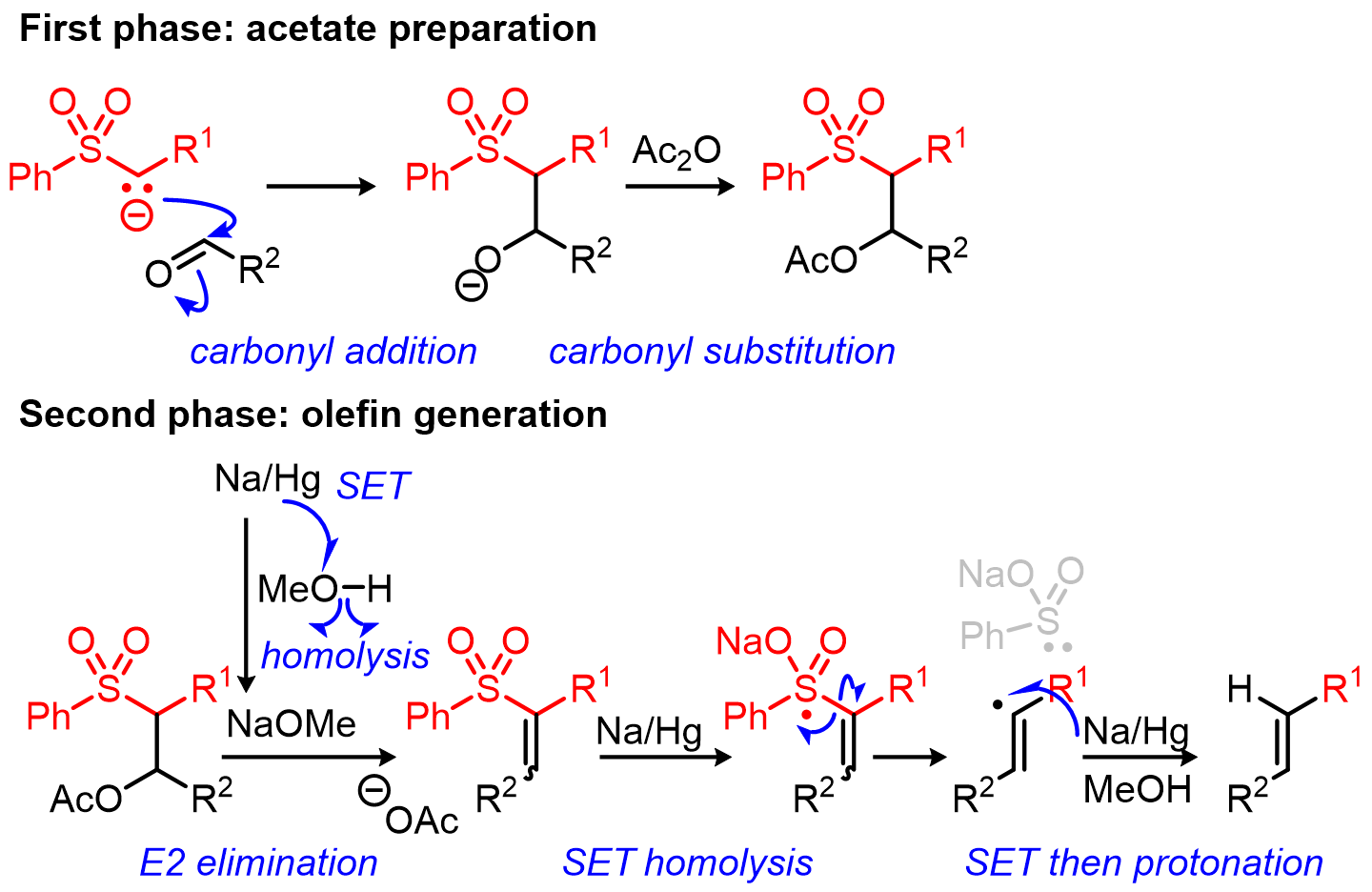
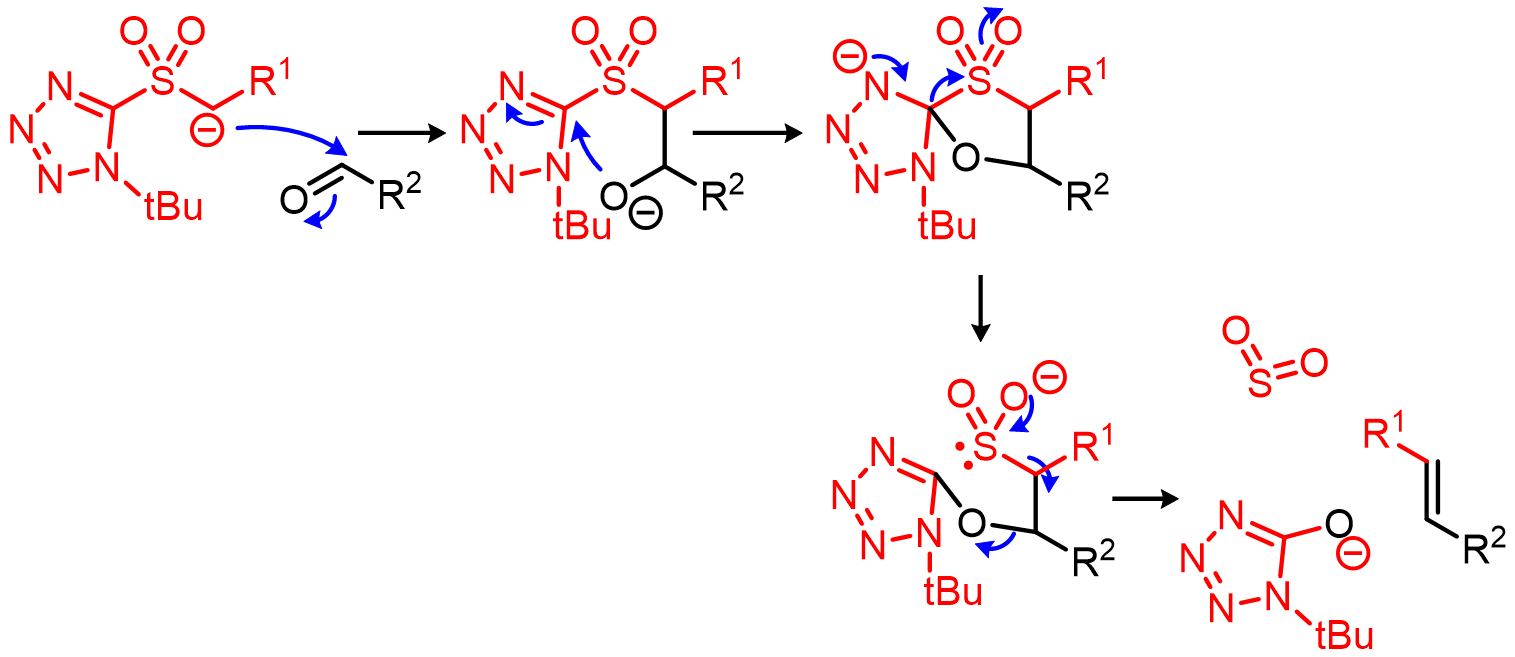
The Julia-Kocienski Olefination uses a heterocyclic sulfone instead of a phenyl one and tends to favor the formation of E alkenes. The heterocycle enables the reaction to proceed without the dissolving metal phase:
Spotted an error, or want a topic covered next? Let us know.