Nucleophilic Aromatic Substitution and Diazoniums
This guide is an early version — the text is complete, and a few figures are still being redrawn. Spotted something unclear? Let us know.
The question this page answers: How do C=C bonds in aromatic rings react with nucleophiles?
Deeper reading: Clayden 2e: Chapter 22 Page 514–525 Chapter 24 Page 567–568 — see our chapter-by-chapter practice map for Clayden.
Two NAS mechanisms
Addition-elimination vs elimination-addition
Nucleophilic aromatic substitution (NAS) reactions typically take place under two different mechanisms:
- Addition-elimination
- Elimination-addition (also known as the benzyne mechanism)
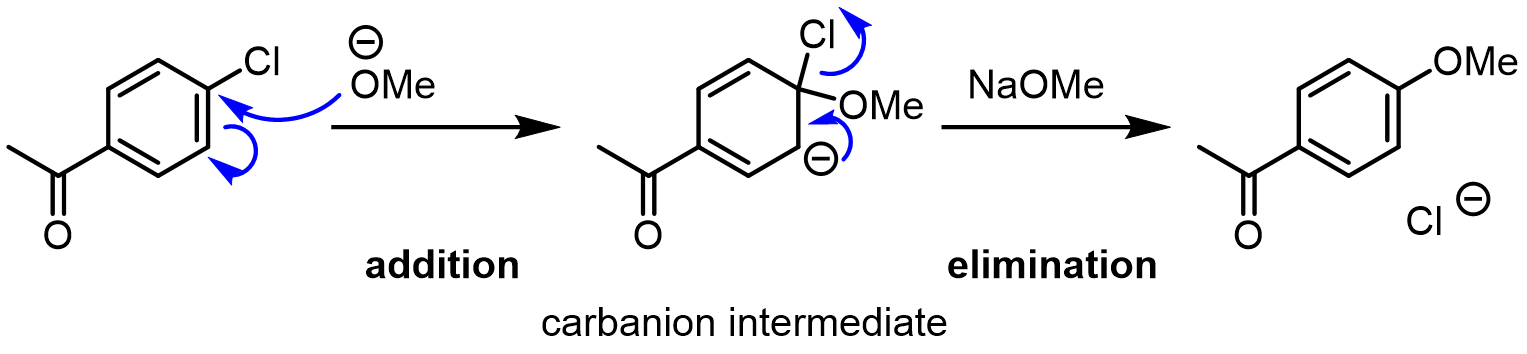
The addition-elimination mechanism is identical to a typical carbonyl substitution reaction, and has a carbanion intermediate:
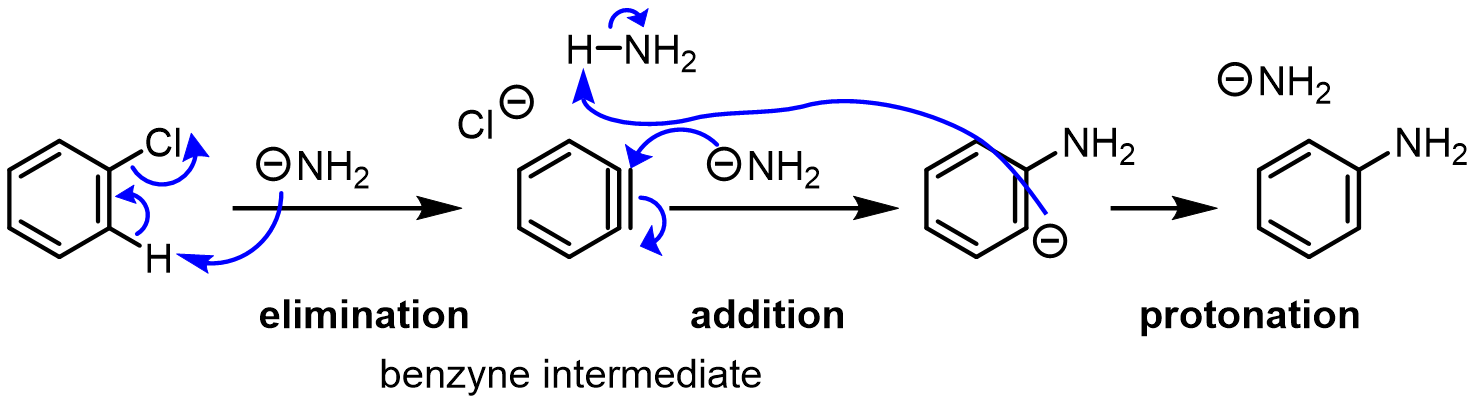
The elimination-addition mechanism goes through a highly reactive benzyne intermediate:
Distinguishing the mechanism
Electron-poor or electron-rich ring?
The type of mechanism at play can be distinguished first by inspection of the aromatic ring:
- Addition-elimination is more likely if the ring is electron poor
- Elimination-addition is more likely if the ring is electron rich
Typical characteristics of reactions following an addition-elimination mechanism are:
- O, N, or CN nucleophile
- There is a good leaving group (often a halogen, with F > Cl ~ Br > I)
- There is a strong EWG ortho and/or para to the leaving group.
Typical characteristics of reactions following an elimination-addition mechanism are:
- Nucleophiles that are strong bases
- The C atom with the leaving group is not necessarily the one the nucleophile adds to
Aryl diazonium substitutions
Three typical diazonium mechanisms
Alternatively, aryl diazoniums undergo a variety of substitutions very easily. There are three typical mechanisms:
- SN1 substitution
- Electron transfer
- Adduct formation
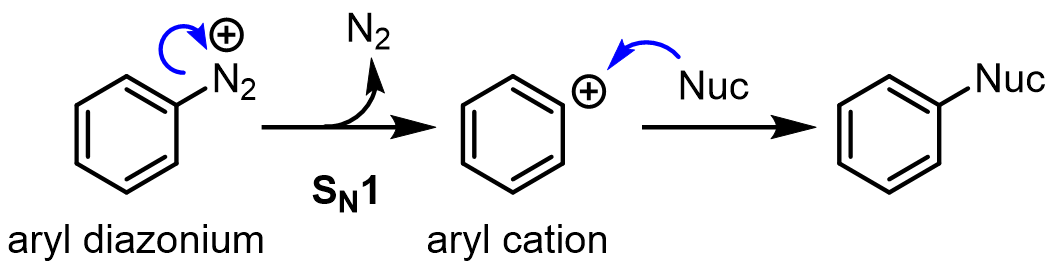
The SN1 mechanism (a leaving group spontaneously leaves) involves the loss of N2 to form a carbocationic intermediate:
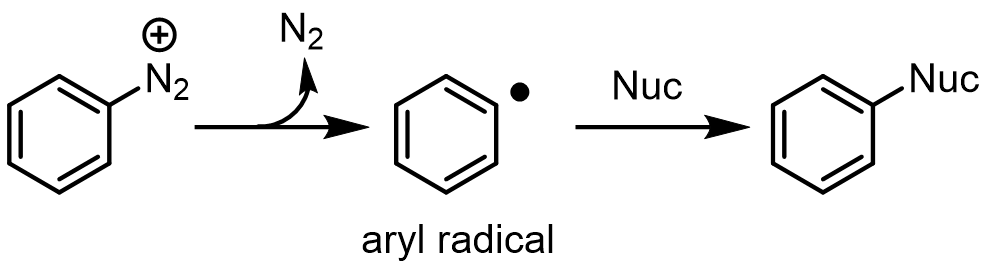
The electron transfer mechanism goes through an aryl radical intermediate, the mechanistic details are outside our scope:
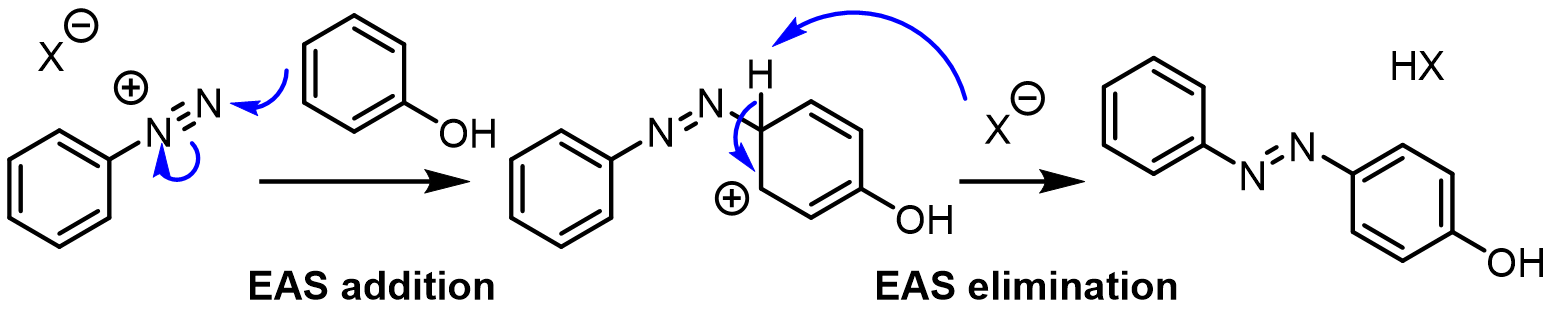
Adduct formation looks more like an EAS reaction that results in the formation of a diazo compound:
Spotted an error, or want a topic covered next? Let us know.