Nucleophilic Addition to Carbonyls
This guide is an early version — the text is complete, and a few figures are still being redrawn. Spotted something unclear? Let us know.
The question this page answers: How do different types of nucleophiles react with carbonyls? How does the mechanism of reaction depend on the reaction conditions?
Deeper reading: Clayden 2e: Chapter 6 Page 125–140, Chapter 11 Page 222–229 — see our chapter-by-chapter practice map for Clayden.
The carbonyl group is electrophilic at C
Why is the C=O carbon electrophilic?
The carbonyl group (C=O) is electrophilic at the C atom.
This electrophilicity at C can be understood using either valence bond or MO thinking.
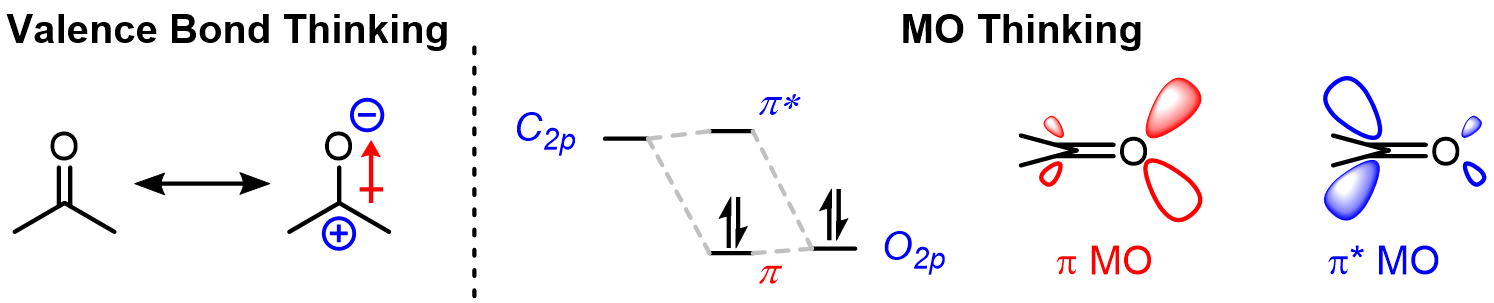
The MO diagram shows the mixing of p orbitals to create the C=O π bond. For reasons beyond the scope of this class, MOs tend to look more similar to the atomic orbital they are closest in energy to, therefore the π* orbital is located more on C than O.
Acidic, neutral, or basic reaction conditions
How do conditions change the mechanism?
Nucleophiles can attack C=O at the C, forming a new Nucleophile–C bond while breaking the C=O π bond. The mechanism of this process depends on the reaction conditions.
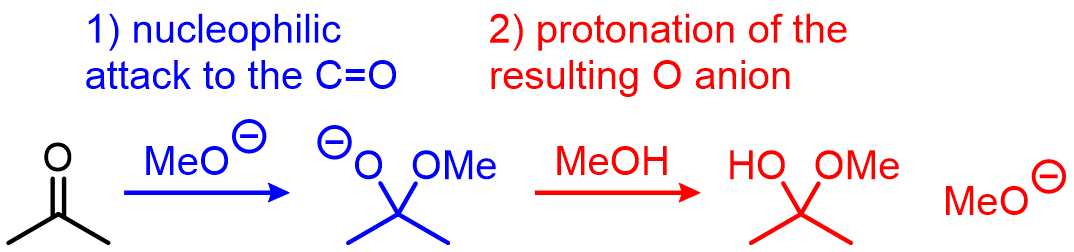
Reaction conditions can be thought of as being acidic, neutral, or basic:
- Acidic Reaction Conditions – more common for weaker nucleophiles. Acid is required to make the carbonyl more electrophilic.
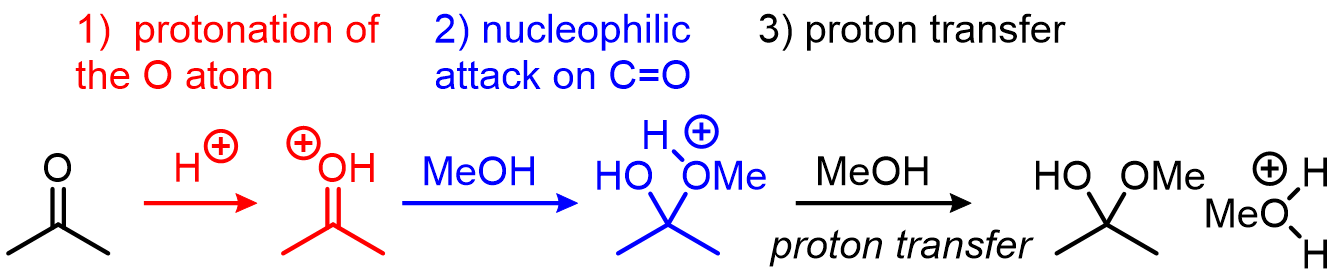
- Neutral Reaction Conditions
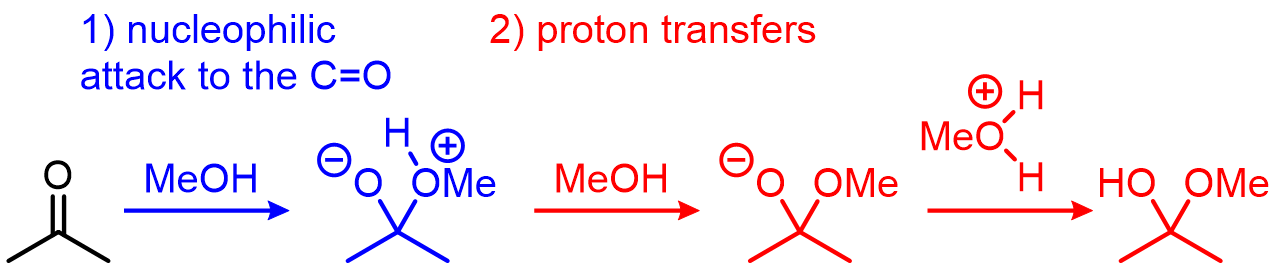
- Basic Reaction Conditions – more common for stronger nucleophiles.
Common transformations from weak to strong nucleophiles
Which nucleophile gives which product?
The reaction conditions and reagents required for addition to a carbonyl depend on the strength and type of nucleophile being added. For now, we are focused only on ketones and aldehydes.
Here are some of the common transformations that are categorized as being a nucleophilic addition to a carbonyl, in order from weak to strong nucleophiles:
- Addition of CN— (cyanide) to C=O creates a cyanohydrin. This reaction is typically under equilibrium:

- Addition of O-nucleophiles (alcohols or alkoxides) to C=O leads to hydrates, hemiacetals, and acetals. This reaction is typically under equilibrium:

- Addition of H— (hydride) to C=O creates an alcohol. This reaction is considered a reduction reaction. H— itself is too good of a base so we need a milder source of H—, which is some type of B–H (borohydride) containing molecule:

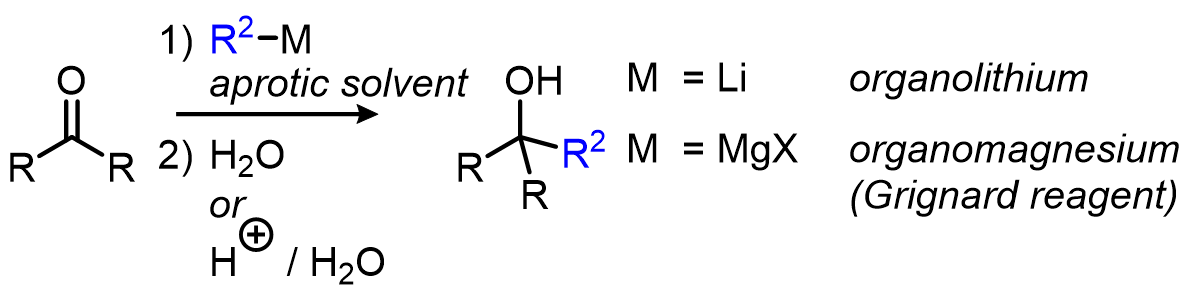
- Addition of R— (carbanion) to C=O creates an alcohol. The practicality of this reaction depends on whether there are other acidic protons in the molecule. Because of the basicity and reactivity of R—, reactions are often done cold (–78 °C), and the OH proton is introduced to the reaction in a second step.
Spotted an error, or want a topic covered next? Let us know.