IUPAC Nomenclature
This guide is an early version — the text is complete, and a few figures are still being redrawn. Spotted something unclear? Let us know.
The question this page answers: How do organic chemists name molecules unambiguously given the near infinite combinations of atoms possible?
Deeper reading: Clayden 2e: Chapter 2 Page 33–42 — see our chapter-by-chapter practice map for Clayden.
A rigorous system for unambiguous names
What are the 4 key pieces?
The International Union of Pure and Applied Chemistry (IUPAC) has come up with a rigorous system for giving each unique organic molecule an unambiguous name. This system is called IUPAC Nomenclature, and contains 4 key pieces of information:
- stereochemical indicators
- prefixes for other substituents
- root for parent framework
- suffix for principal FG
A simplified but still sufficiently detailed method for IUPAC Nomenclature follows 6 steps for each molecule.
Stereochemical indicators are discussed later in the Stereochemistry notes.
The format of an IUPAC name
Indicators–prefixes–root–suffix
IUPAC nomenclature has the following format:
stereochemical indicators–prefixes–root for parent framework–suffix for principal FG
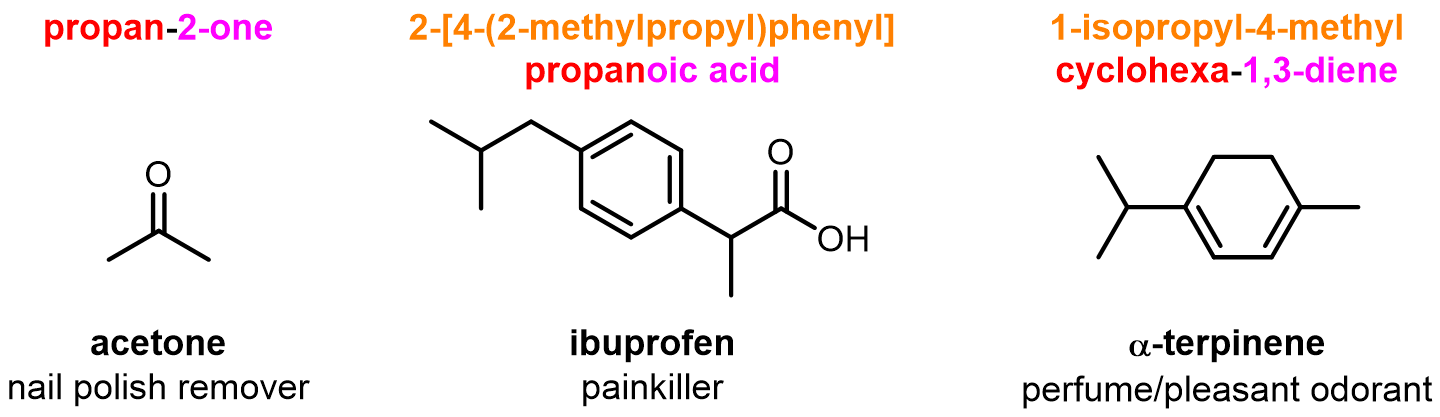
Here are the IUPAC names for a couple common molecules:
A 6-step method
From principal FG to stereochemistry
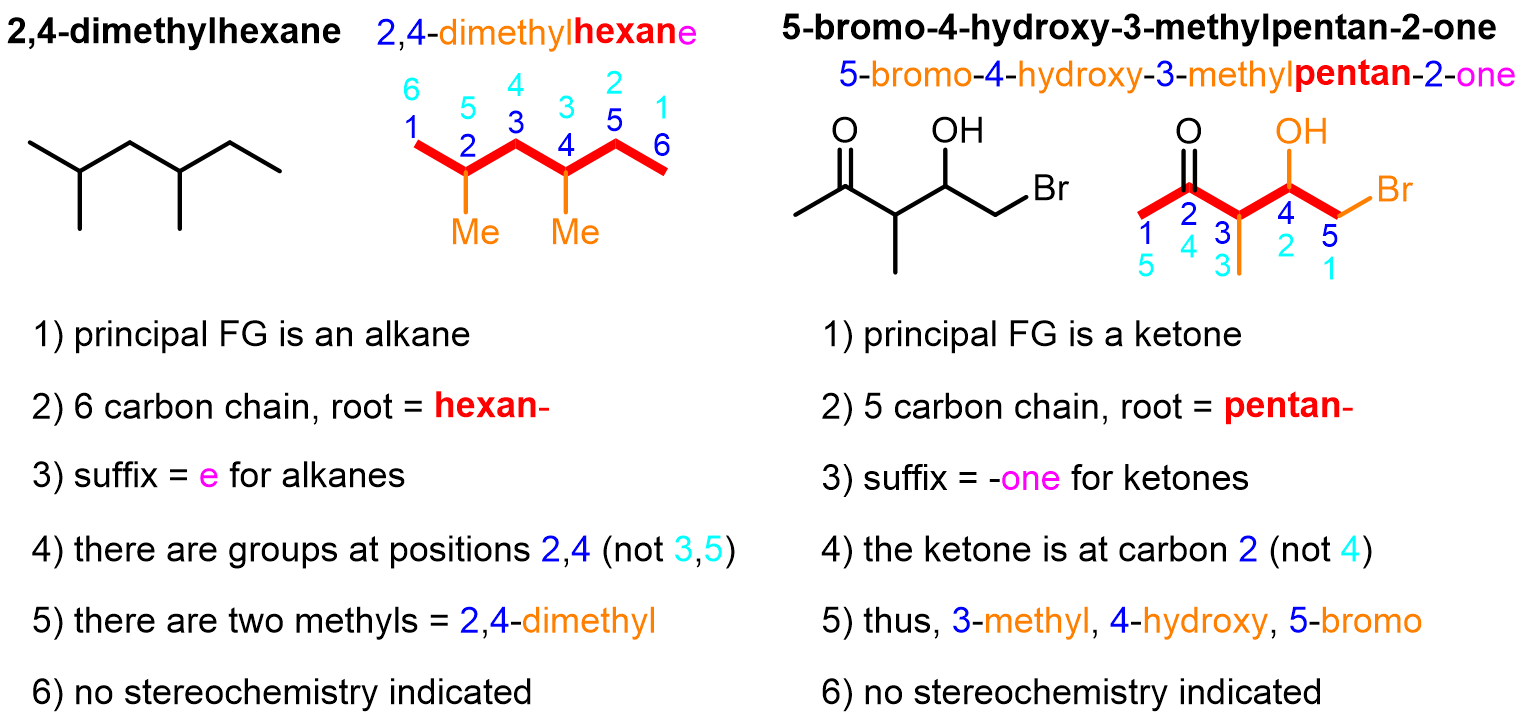
Here is a 6-step method for IUPAC nomenclature:
- Identify the principal FG (i.e. highest ranked FG) using the table on the Brief Guide to IUPAC Nomenclature Handout.
- Identify and name the root for the parent framework (chain or ring) containing the FG from Step 1. If multiple possibilities exist, rings > chains, long chains > short chains, more multiple bonds > less multiple bonds.
- Apply the appropriate suffix to the parent framework name from Step 2.
- Assign lowest possible locant (i.e. #) to the position of the principal FG. Start from an end in chains. For ties, pick the option with lowest # at first point of difference. If none, then alphabetize prefixes and give first substituent lowest possible #.
- Alphabetically list the appropriate prefixes and numbering/lettering for other substituents along the parent framework.
- If applicable, add stereochemical and other indicators (e.g. R/S or E/Z)
Here are two examples of this nomenclature method in action:
Spotted an error, or want a topic covered next? Let us know.