Chemical Reactions: Why and How
This guide is an early version — the text is complete, and a few figures are still being redrawn. Spotted something unclear? Let us know.
The question this page answers: Why and how do molecules react with each other?
Deeper reading: Clayden 2e: Chapter 5 Page 107–124 — see our chapter-by-chapter practice map for Clayden.
Two effects control reactivity
Electronic effects and steric effects
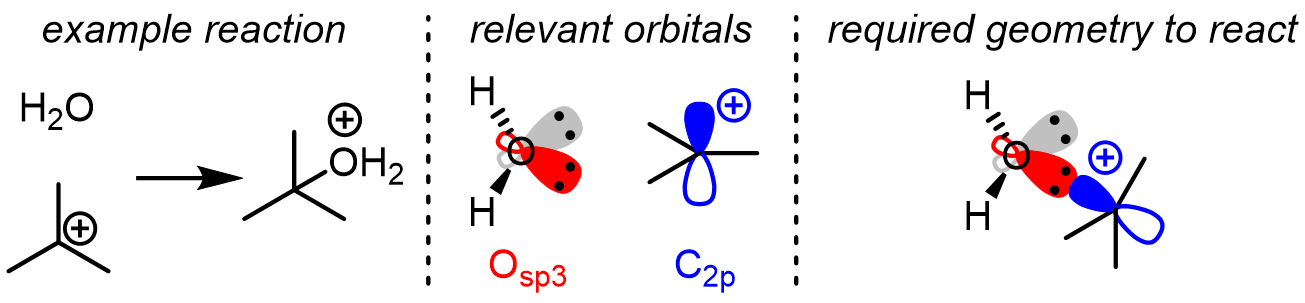
To react, molecules need to collide in the correct geometry and overcome an activation energy barrier before forming new bonds.
Two effects control the reactivity of molecules and the outcome of chemical reactions:
- Electronic effects. These forces bring molecules together
- Charge/dipole attraction.

- Orbital overlap
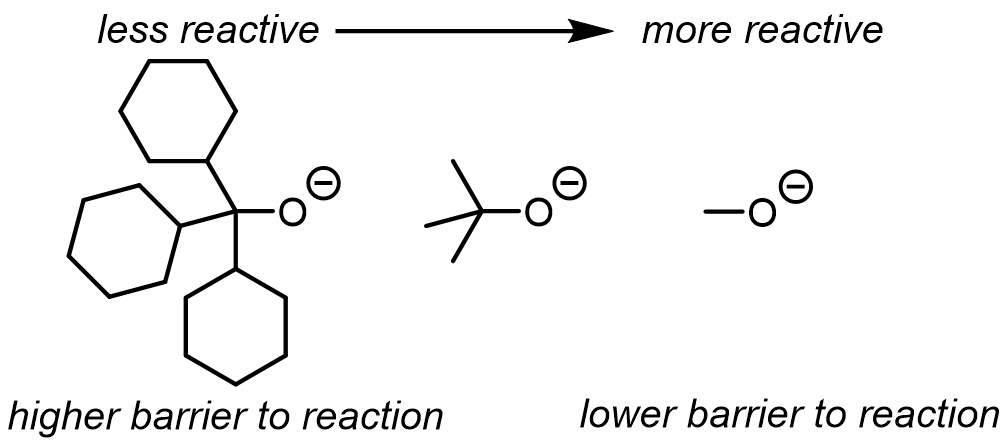
- Steric effects. Molecular size and shape affect size of the activation energy barrier.
Nucleophiles and electrophiles
Where do electrons flow in a reaction?
In typical reactions, electrons in a HOMO of one molecule flow into an empty LUMO of another molecule, therefore turning higher energy reactants into lower energy products.
The electron donor is called the nucleophile (Nuc) while the electron acceptor is called the electrophile (E+). There are two types of energy diagrams to consider when thinking about reactions.
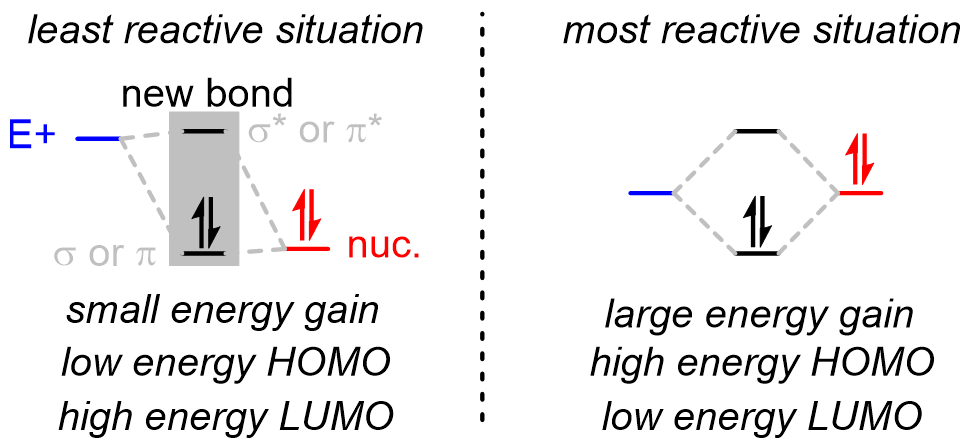
- Simplified MO diagrams show how orbitals overlap to make a new bond. This process can be viewed as electrons flowing from nucleophile to electrophile in the process of forming new bonding and anti-bonding orbitals. The nucleophilic pair of electrons becomes more stabilized.
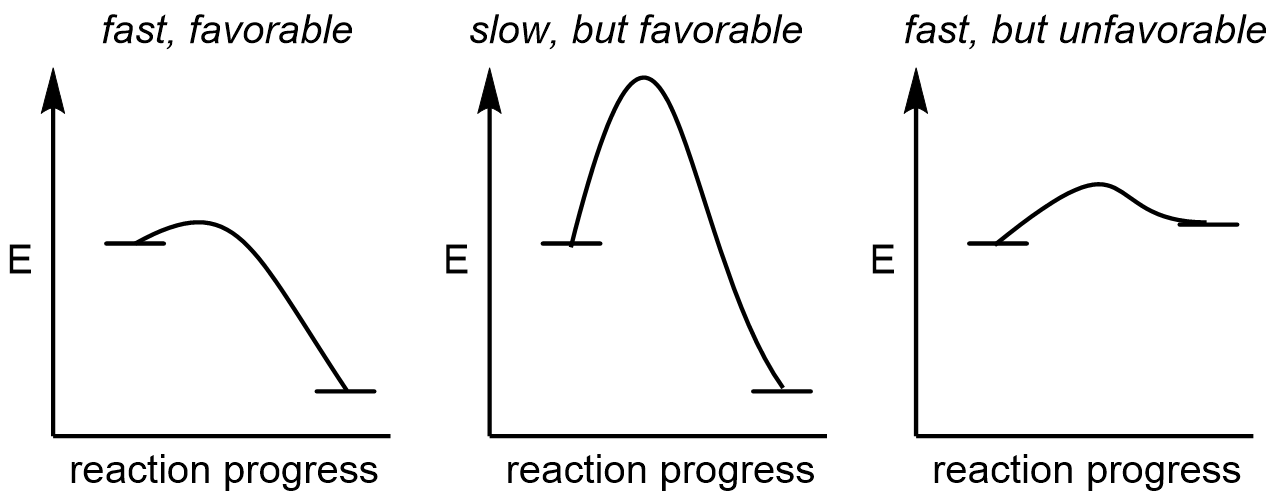
- Reaction coordinate diagrams show the relative energies of reactants and products:
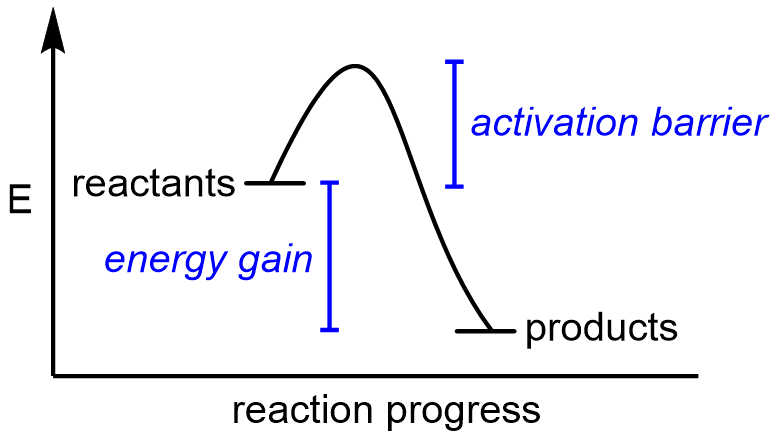
- Note that the activation barrier tells you the rate of the reaction, while the energy gain tells you how favorable a reaction is. This contrast is often summed up as kinetics (rate) vs. thermodynamics (energy gain).
Nucleophilic sites
Lone pairs > C=C π bonds > σ bonds
Within a molecule that is considered a nucleophile, there are specific pairs of electrons that are nucleophilic sites.
The highest energy electrons will be the most nucleophilic. There are three types of nucleophilic sites, in order from highest to lowest nucleophilicity:
- Lone pairs: less electronegative atoms have more nucleophilic lone pairs. Formal negative charge increases nucleophilicity:

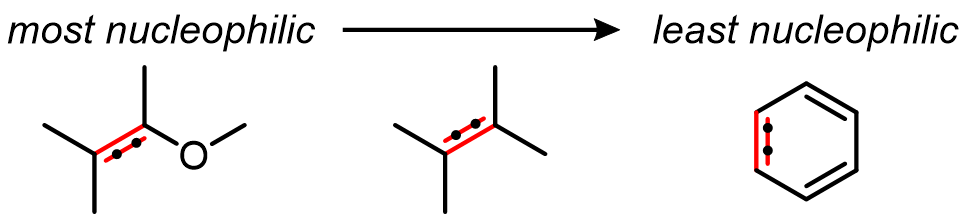
- C=C π bonds: C=Z bonds are almost always electrophilic, not nucleophilic. C=C bonds with more electron density are more nucleophilic:
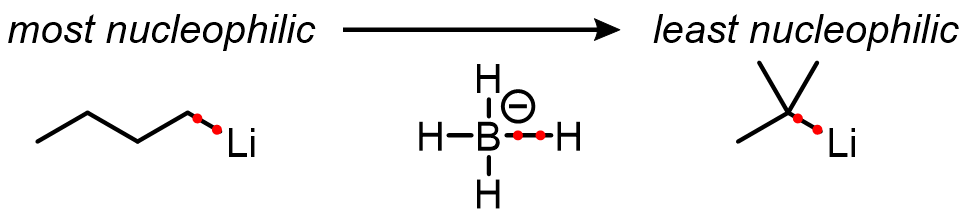
- σ bonds: this is typically observed with σ bonds between atoms that are less electronegative (more electropositive) than C.
Electrophilic sites
Empty AOs > σ* > π*
Within a molecule that is considered an electrophile, there are specific empty orbitals that are electrophilic sites.
The lowest energy unoccupied MO (LUMO) will be the most electrophilic. There are three types of electrophilic sites, in order from highest to lowest electrophilicity:
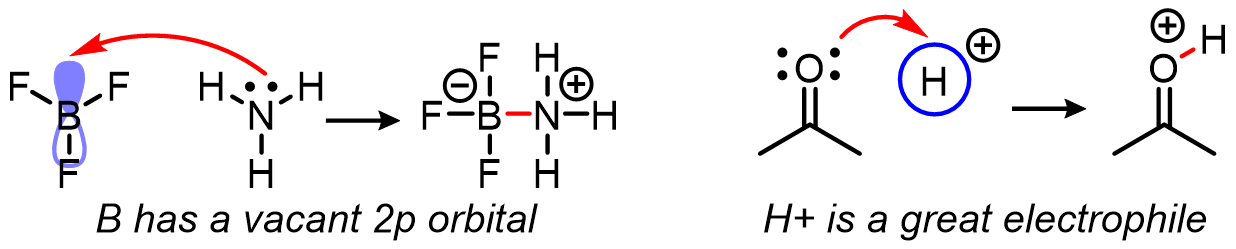
- Empty atomic orbitals: these are usually empty p orbitals. In the case of H+, it is an empty 1s orbital:
- C–Z anti-bonding orbitals: these are σ* orbitals that are low in energy, usually this is the case when Z is more electronegative than C, or if Z is polarizable:
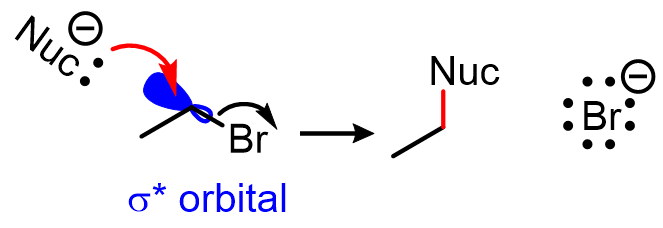
- C=Z anti-bonding orbitals: these are π* orbitals that are low in energy. Here, Z doesn’t have to be electronegative:
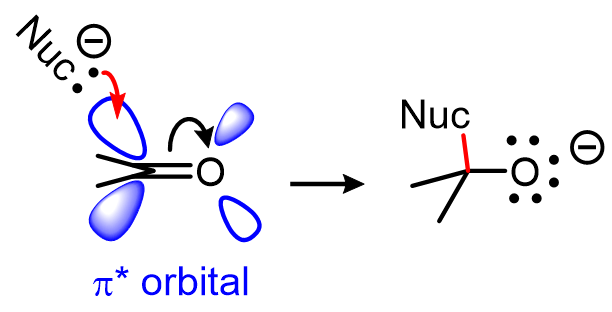
Curly mechanistic arrows
Electron pair → empty orbital
Curly mechanistic arrows are used to understand the flow of electrons from nucleophile to electrophile in a reaction.
Arrows always start from a pair of electrons (i.e. the nucleophilic site) and end in an empty orbital (i.e. the electrophilic site). If the arrowhead lands in…
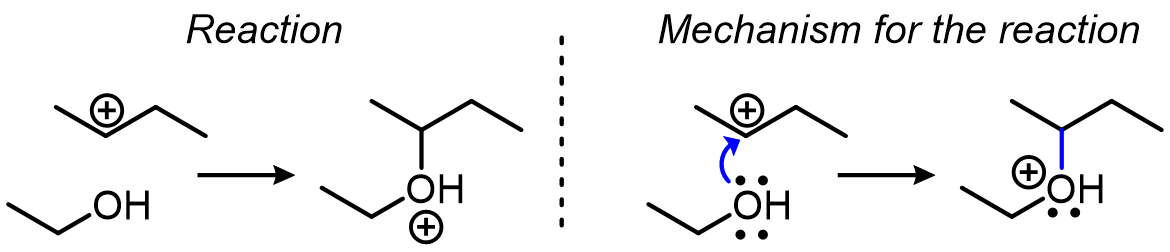
- an empty atomic orbital, then a new bond is formed between the nucleophilic and electrophilic atoms and no further arrows are needed.
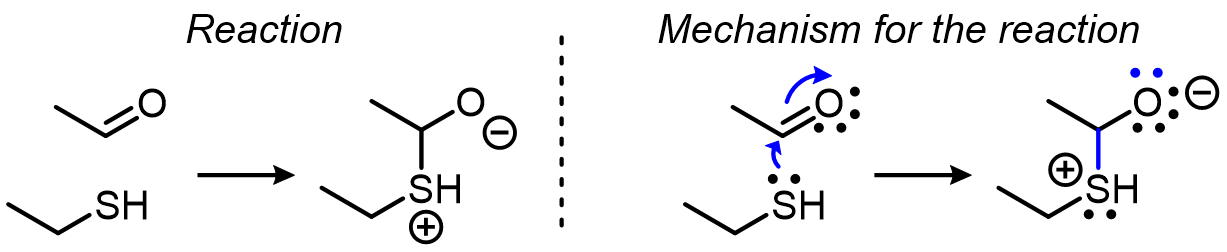
- an anti-bonding MO, then a new bond is formed and the corresponding old bond (which is representative of the bonding MO) is broken, so more arrows are needed.
- an electronegative atom, then a negative charge is introduced and no more arrows are needed.
Here is an example that demonstrates principle 1:
Here is an example that demonstrates principles 2 and 3:
Spotted an error, or want a topic covered next? Let us know.