Functional Groups
This guide is an early version — the text is complete, and a few figures are still being redrawn. Spotted something unclear? Let us know.
The question this page answers: How do organic chemists categorize the common groupings of atoms within molecules?
Deeper reading: Clayden 2e: Chapter 2 Page 22–33 — see our chapter-by-chapter practice map for Clayden.
Linear carbon chains
Prefix for length, suffix for bonds
All organic molecules are built from carbon atoms that are arranged in chains and/or rings. Linear carbon atom chains are referred to by
- a prefix for its # of C atoms
- a suffix reflecting the presence of multiple bonds
Here are prefixes for the most common chain lengths.

Here are the suffixes:

Here are some examples of linear carbon chains:

Carbon rings
Cycloalkyl, aromatic, anti-aromatic
Carbon rings are subclassified into three types:
- cycloalkyl rings do not have a complete cycle of pi bonds
- aromatic and anti-aromatic rings are special cases that emerge when there is a complete cycle of π-electrons around the ring
For cycloalkyl rings, add the cyclo- prefix to the normal chain name:
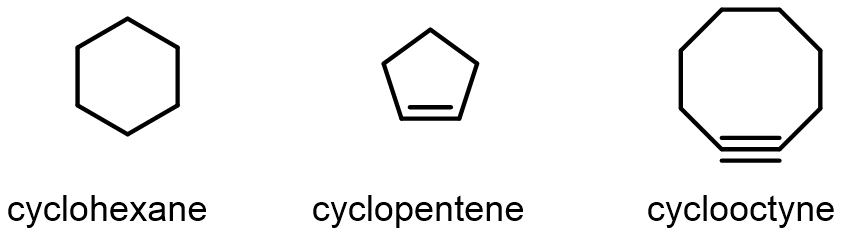
For aromatic rings, there is unfortunately no systematic naming scheme. Here are some of the common ones.

The -yl suffix
How are attached groups named?
When referring to a group that is attached to other atoms, use the -yl suffix in place of the -e.
Here are examples of -yl usage:

Phenyl refers to a benzene ring, aryl refers to any generic aromatic ring, and alkyl refers to a generic chain.
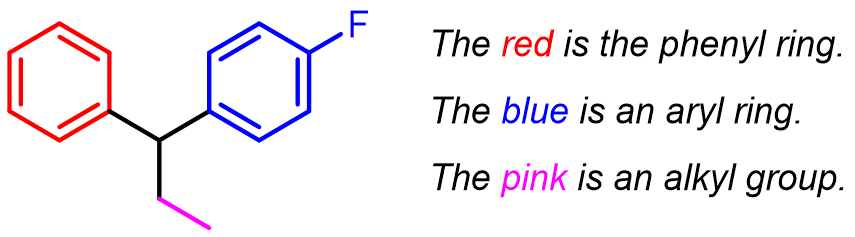
Abbreviations in line-angle drawings
Me, Et, Ph, Ar, R, X
Chemists often use abbreviations in line-angle drawings. These are for -yl groups and should only be used at the end of a chain.
Me = methyl, Et = ethyl, Ph = phenyl, Ar = aryl, R = alkyl (sometimes aryl), X = halide

Functional groups and oxidation levels
What makes a group “functional”?
Functional groups (FGs) are common groupings of atoms with chemical properties that are responsible for characteristic reactions in a molecule.
One way to classify functional groups is by oxidation level, which is defined as the number of bonds to heteroatoms (i.e. non-C or H atom) the C atom has:
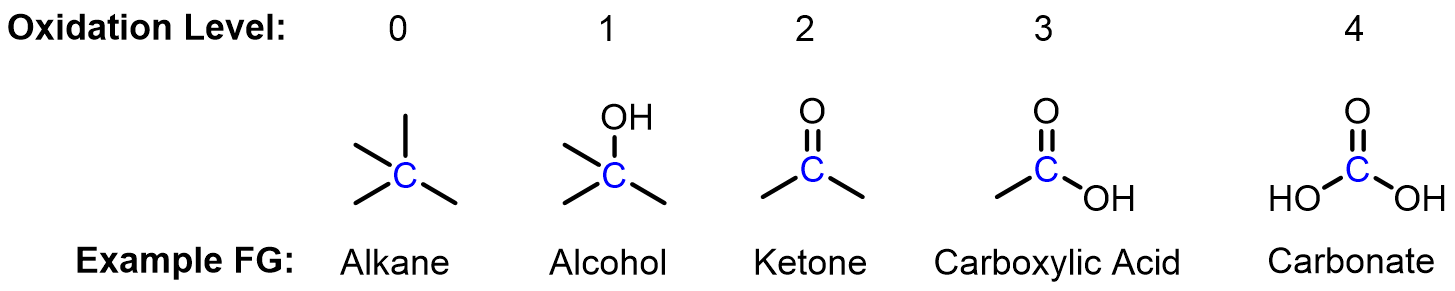
Note: first oxidation level FGs do not include the C atom while second, third, and fourth oxidation level FGs do.
Functional group modifiers
Degree of substitution and attachment
Modifiers are helpful for providing more structural context to the FG.
Degree of substitution typically refers to the number of groups attached to the C atom of a functional group. This modifier is used mostly for first oxidation level FGs.

In amines and amides, however, it is the number of groups attached to N that matters:
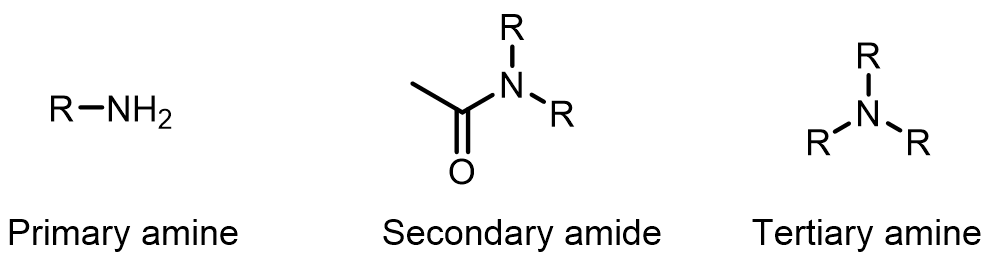
FG properties may be different if the FG is attached to an sp2 C atom or separated from one by an sp3 C atom.

Spotted an error, or want a topic covered next? Let us know.