Enols and Enolates as Nucleophiles
This guide is an early version — the text is complete, and a few figures are still being redrawn. Spotted something unclear? Let us know.
The question this page answers: What do reactions using enols and enolates as nucleophiles look like?
Deeper reading: Clayden 2e: Chapter 20 Pages 460–470 and Chapter 25 584–613 — see our chapter-by-chapter practice map for Clayden.
Enols and enolates as carbanion nucleophiles
Where do enols and enolates come from?
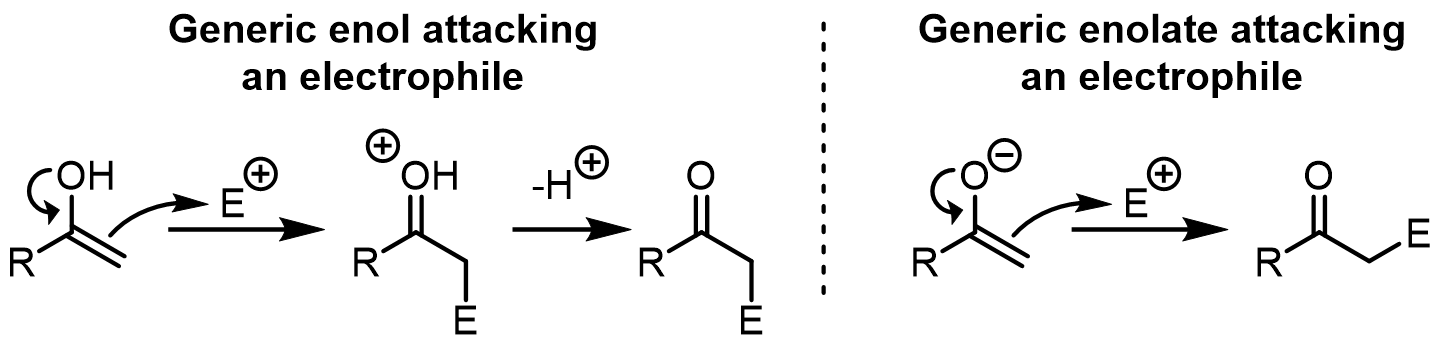
Enols and enolates are carbanion nucleophiles that react with a variety of electrophiles.
Enols are produced by acid-catalyzed tautomerization of carbonyl-containing FGs, while enolates are produced by deprotonation of an H α to a carbonyl. Both are nucleophilic.
Deprotonation vs nucleophilic addition
Which wins: addition or deprotonation?
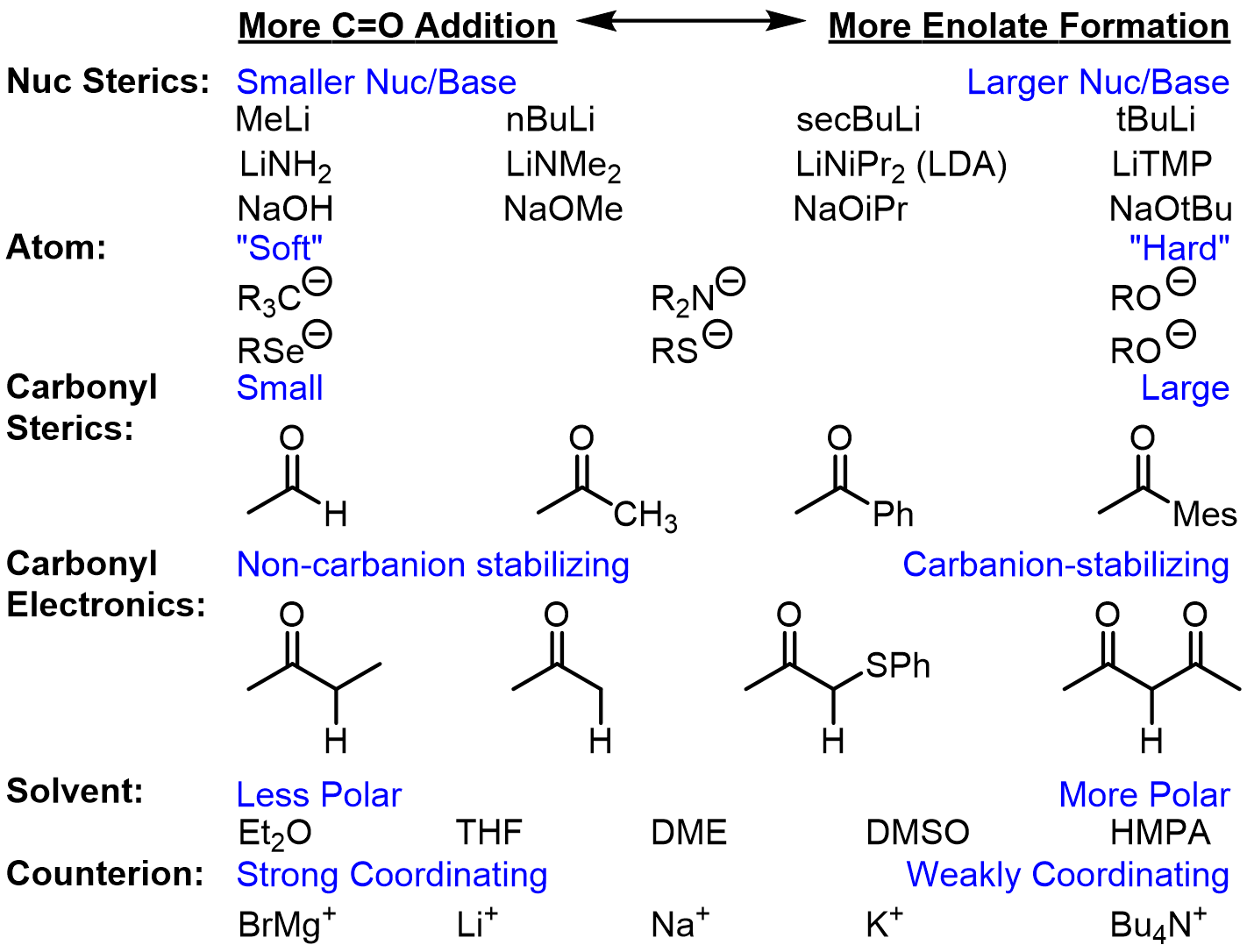
The formation of enolates by deprotonation is in competition with nucleophilic addition to the carbonyl.
Direct addition to carbonyl (left) and enolate formation (right) are shown here:

While in most cases enolate formation can be achieved by using a sterically hindered base, a large variety of factors can affect whether C=O addition or deprotonation is preferred:
Kinetic vs thermodynamic enolates
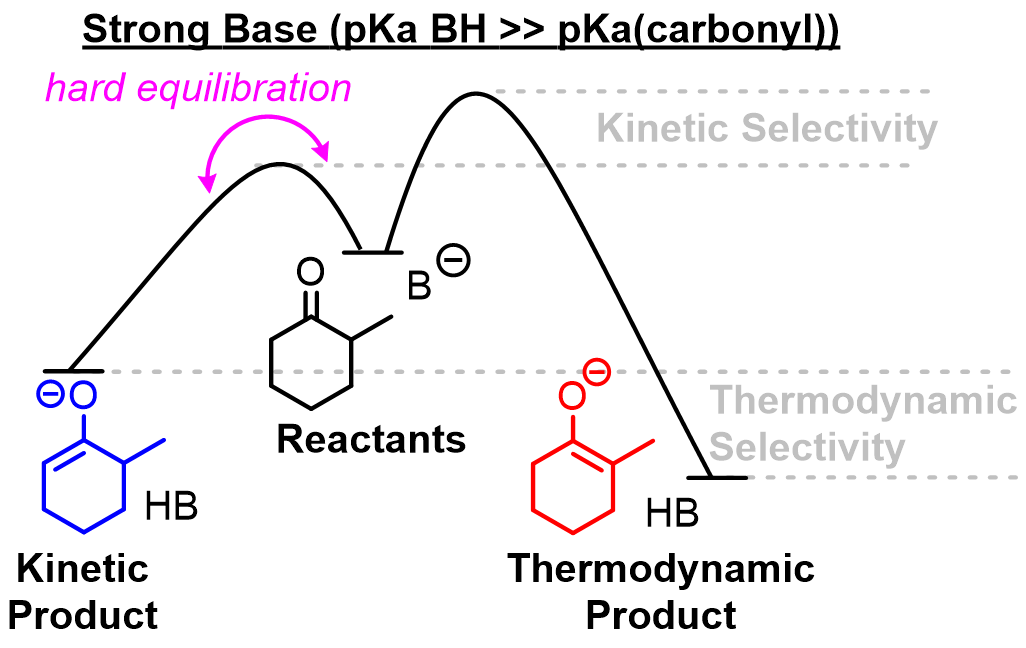
Strong base → kinetic; weak base → thermodynamic
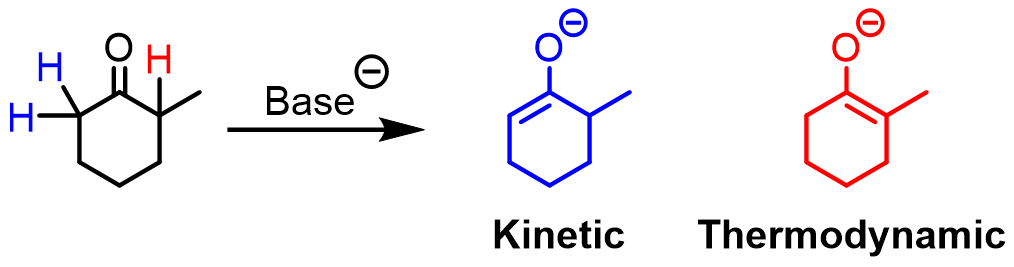
Given a carbonyl, it is often the case that regioisomeric enolates can be formed. These are categorized as being either a kinetic enolate or a thermodynamic enolate.
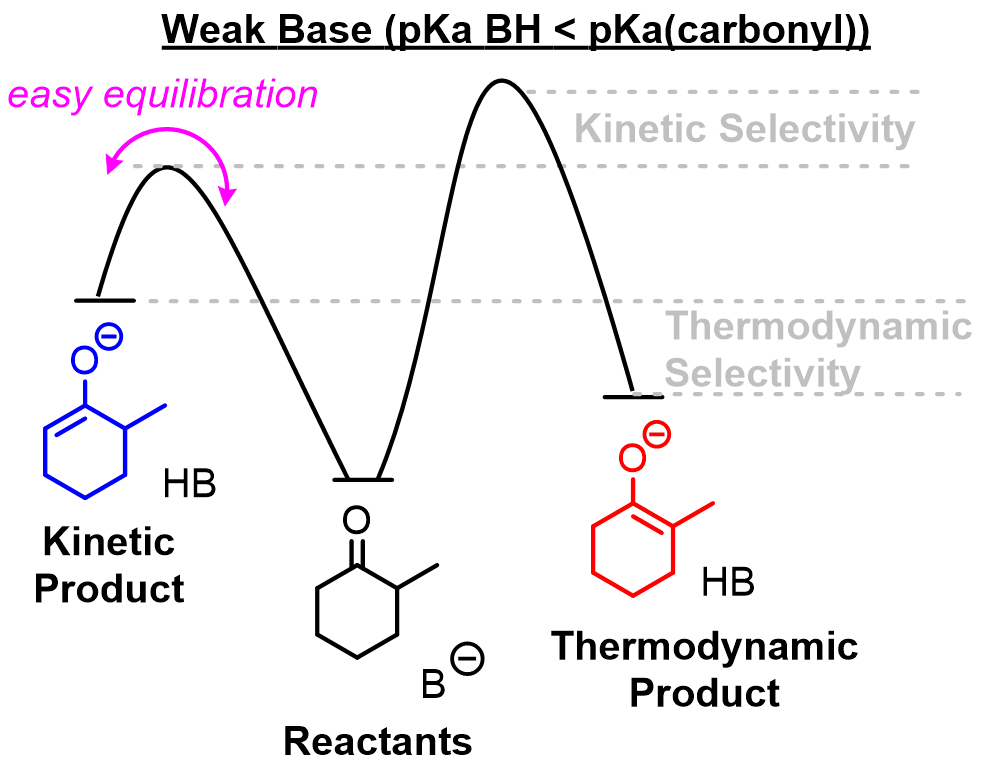
Kinetic enolates are typically less substituted and form quickly compared to thermodynamic enolates, which are the more stable enolate but are harder to form:
When a strong base is used, deprotonation is relatively easy and the products of deprotonation are more stable than the reactants. Because equilibration from kinetic to thermodynamic is hard, the kinetic enolate is produced:
When a weak base is used, deprotonation is relatively hard, and the products of deprotonation are less stable than the reactants. Because equilibration from kinetic to thermodynamic is easy, the kinetic enolate equilibrates quickly into the thermodynamic one:
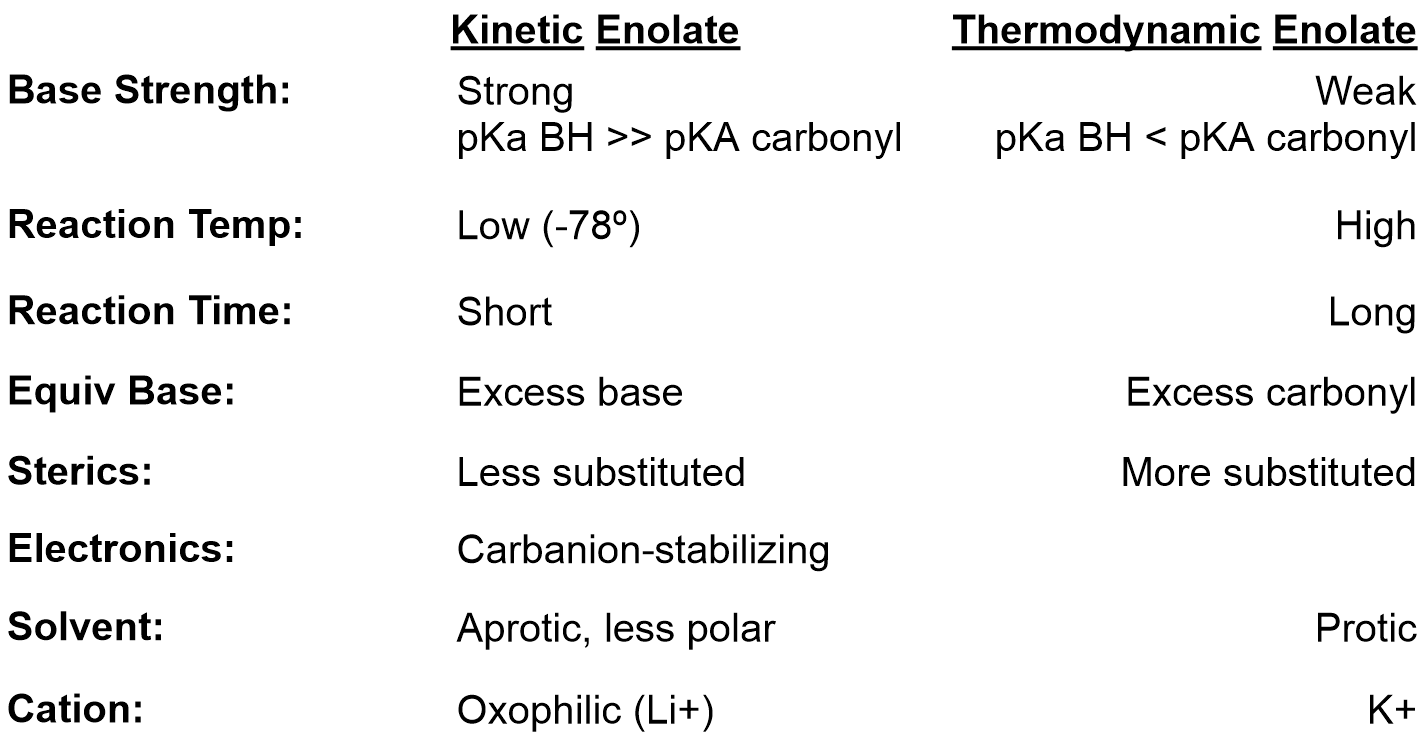
A large variety of factors determine whether the kinetic or thermodynamic product is formed preferentially:
Enolate equivalents
Which electrophiles react with each equivalent?
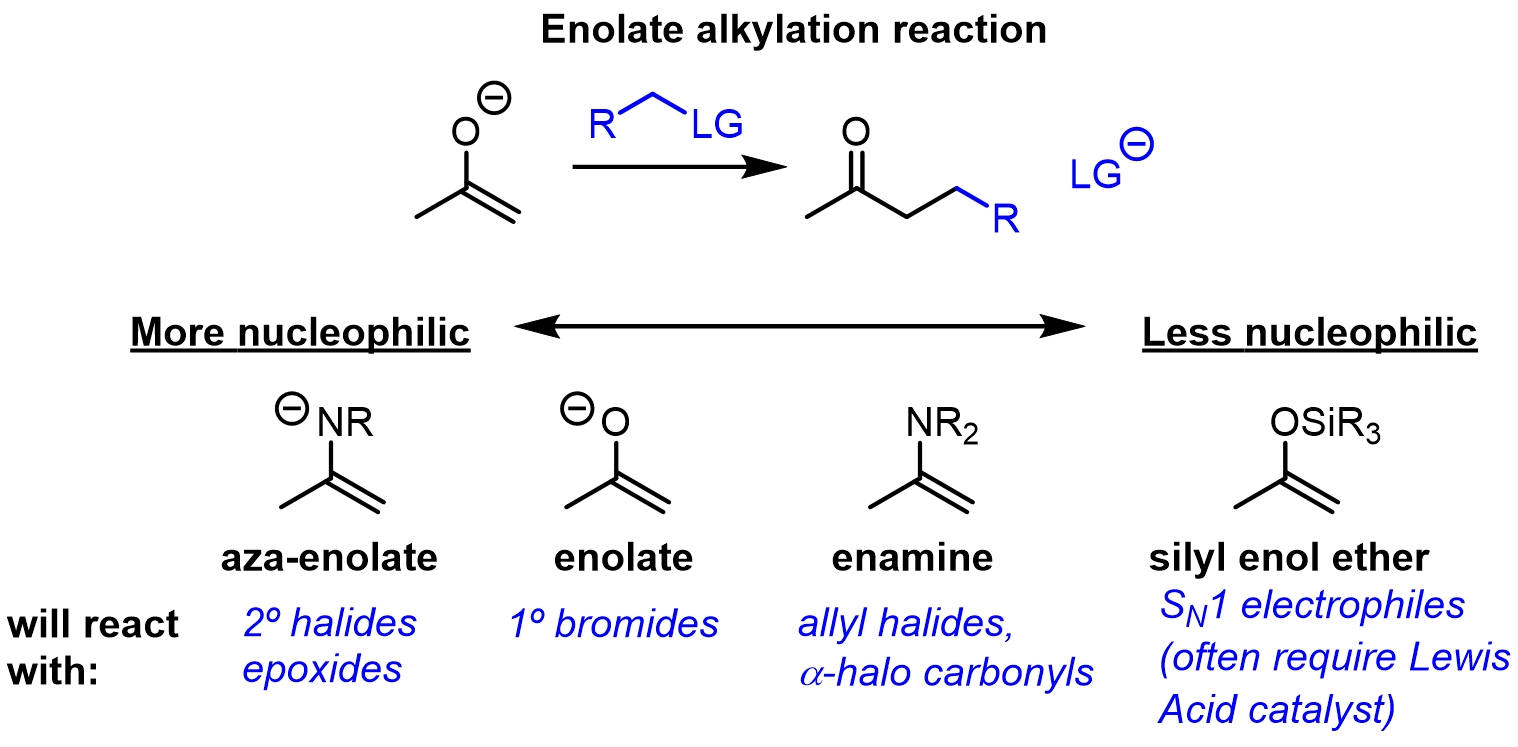
There are a variety of enolate equivalents that react similarly to enolates.
Enolates and their equivalents have varying levels of nucleophilicity. The weakest electrophiles that will react with the given enolate / enolate equivalent in an enolate alkylation reaction are shown here:
Reactions with carbonyl electrophiles
Aldol, Claisen, Michael, Robinson
Enolates and their equivalents are typically reacted with carbonyl electrophiles.
An aldol addition involves an enol(ate) nucleophile and an aldehyde/ketone electrophile. Depending on the reaction conditions, an aldol condensation may also occur:

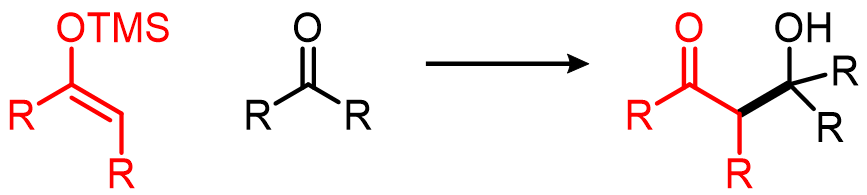
In the Mukaiyama Aldol Reaction, a silyl enol ether is reacted with a Lewis Acid-activated electrophile:
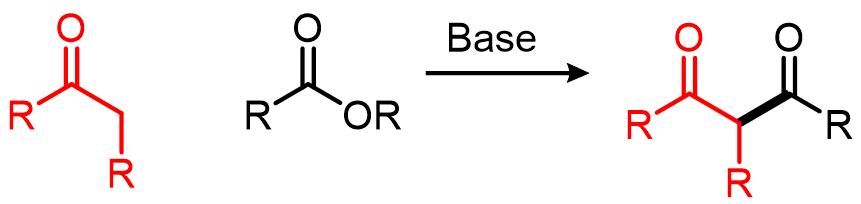
A Claisen (intermolecular) or Dieckmann (intramolecular) Condensation takes place if an ester is used as the electrophile because the electrophilic carbonyl can be reformed by tetrahedral intermediate collapse:
A Michael Addition is a reaction in which a stabilized carbanion nucleophile undergoes a 1,4-addition with a conjugated carbonyl:

Finally, the Robinson Annulation is a combined aldol reaction and Michael addition that can result with an enolate is reacted with a conjugated carbonyl, resulting in the formation of a new ring:

Spotted an error, or want a topic covered next? Let us know.