Drawing Organic Molecules
This guide is an early version — the text is complete, and a few figures are still being redrawn. Spotted something unclear? Let us know.
The question this page answers: How do chemists communicate with each other about organic molecules?
Deeper reading: Clayden 2e: Chapter 2 Page 15–22 — see our chapter-by-chapter practice map for Clayden.
Four types of representations
How do chemists depict molecules?
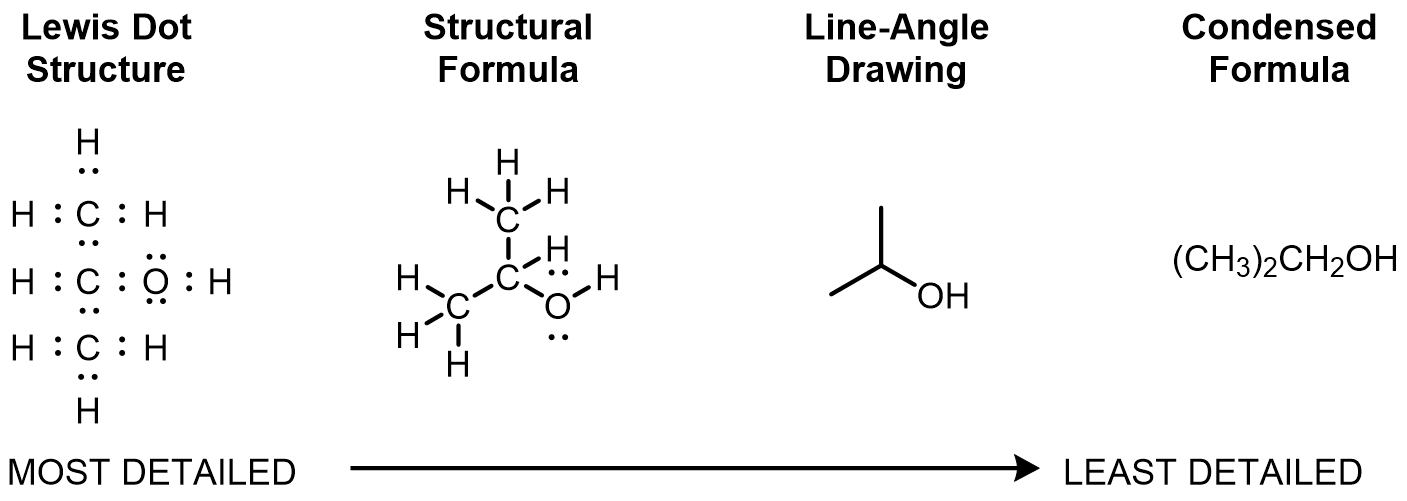
There are four types of representations of molecules used by organic chemists. Line-angle drawings are preferred, and they are sometimes used in combination with condensed formulas.
Here are different representations of isopropanol, also known as rubbing alcohol.
Condensed formulas
When do condensed formulas work best?
Condensed formulas work best for simple linear molecules.
Guidelines:
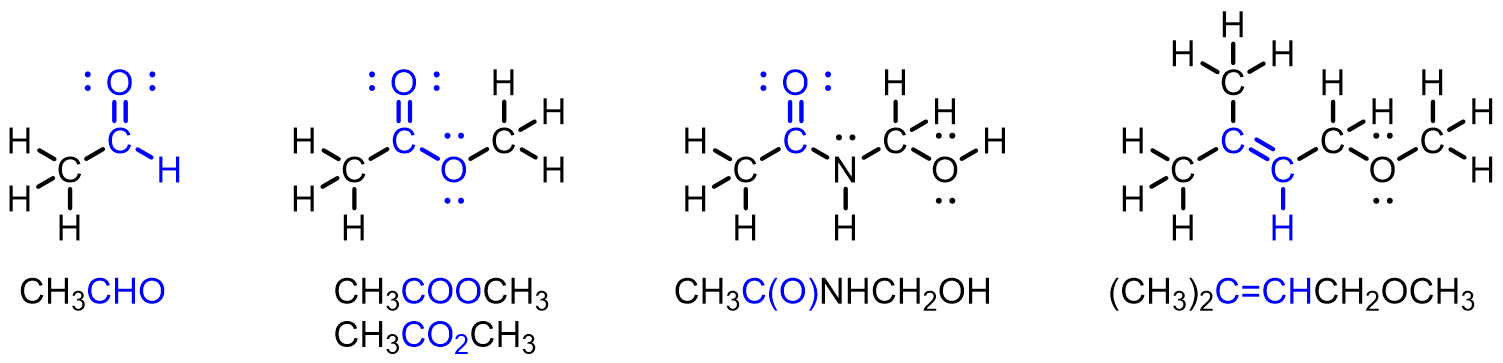
- Parentheses/brackets are used to group and simplify.
- C=O bonds are often implied.
Here are examples of structural and condensed formulas.
Line-angle drawings
Which atom labels are omitted?
Line-angle drawings omit atom labels to simplify drawings.
Guidelines:
- Omit C atom labels.
- Omit H atom labels unless the H atom is attached to a labeled atom.
- Be realistic to actual geometry. This means: 120 bond angles for chains, perfect polygons for rings, and 180 bond angle for triple bonds.
- If you choose to show lone pairs on an atom, you must draw all of the lone pairs.
Here are the line-angle drawings for the four molecules above.

Combining condensed formulas and line-angle drawings
Mixed drawings — watch the hidden H’s
Combining condensed formulas and line-angle drawings is common.

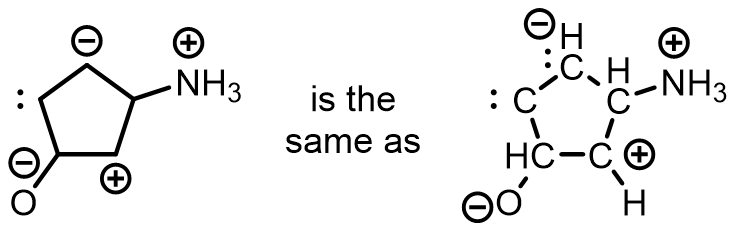
Be careful, the omission of H’s and lone pairs on atoms can make interpretation of line-angle drawings tricky.
Showing three-dimensional information
Wedges, hashes, or perspective view
When there is important three-dimensional information, use either a) birds-eye view and wedged or hashed bonds or b) perspective view from the side of the molecule.

Spotted an error, or want a topic covered next? Let us know.