Conformational Analysis
This guide is an early version — the text is complete, and a few figures are still being redrawn. Spotted something unclear? Let us know.
The question this page answers: What is the actual 3D nature of organic molecules? Are they static or flexible?
Deeper reading: Clayden 2e: Chapter 16 Page 360–379 — see our chapter-by-chapter practice map for Clayden.
Conformations and bond rotation
What relates conformational isomers?
Molecules exist in various conformations (or conformational isomers) that are related by bond rotation.
Here are some examples:

Being able to identify the most stable conformation of a molecule is central to understanding its properties and behavior.
The ratio between conformations can be estimated with the rule of thumb that 1.4 kcal/mol at 298 K is worth roughly one order of magnitude in equilibrium constant K.
Newman projections
How do we visualize bond rotation?
Newman projections are a drawing method that help with visualizing this bond rotation.
Newman projections are drawn from the perspective of looking directly down a C–C bond. Here are a couple examples:
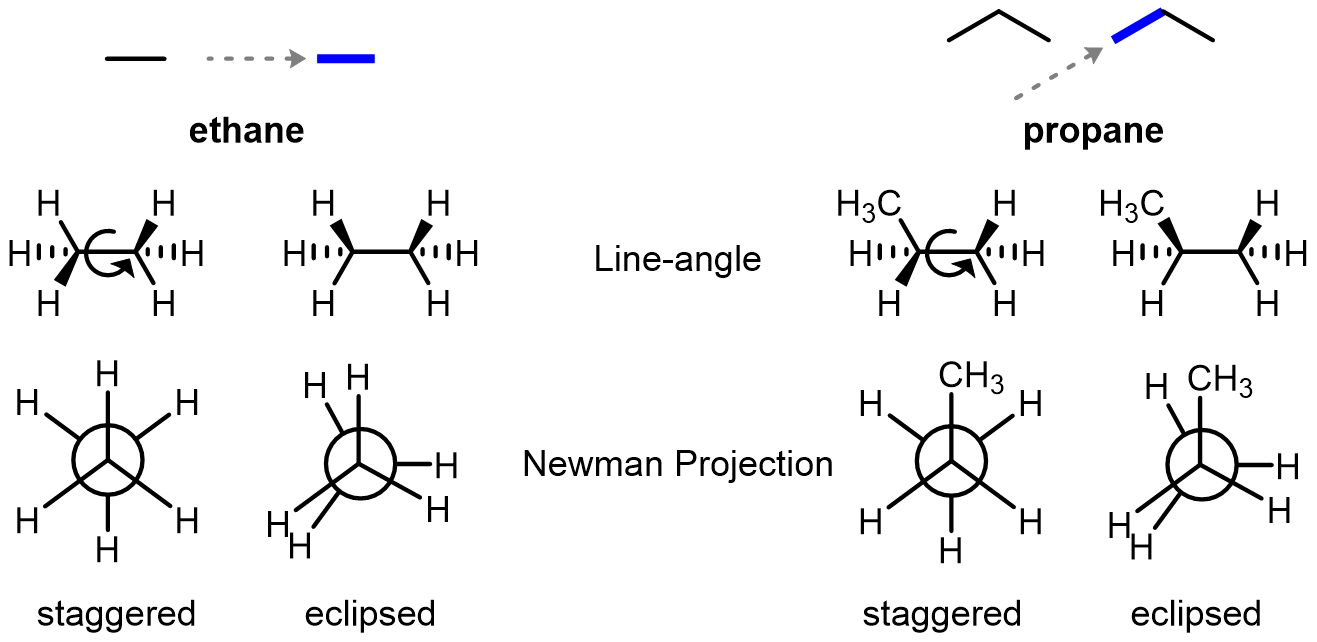
Notice the terminology of “staggered” vs. “eclipsed” to describe how the groups attached to the carbon atoms are rotated with respect to each other.
Why conformations differ in energy
What sets a conformation's energy?
Different conformations of a molecule have different energies because of the balance between stabilizing delocalization or destabilizing repulsion.
Here is an energy diagram for conformations of ethane from Prof. Tim Wallace (Manchester):
Better yet, generate the diagram yourself with a live Newman projection of ethane:
Try this
- Drag the front carbon through one full turn and watch the marker trace the energy curve.
- Park the projection at the top of a hill. Every hilltop is an eclipsed conformation, and each one costs about 2.9 kcal/mol of torsional strain.
- Now settle into a valley. Every staggered conformation of ethane is equivalent, which is why all three valleys sit at exactly the same energy.
The increased energy in eclipsed conformations comes from destabilizing torsional strain that arises from repulsion between electron clouds of the two C–H bonds. Additionally, in the staggered conformation there is stabilizing hyperconjugation interaction between the σ C–H orbital and the parallel anti-bonding σ* C–H orbital:

Syn-periplanar, anti-periplanar, and gauche
Naming butane conformations
When there are more substituents, things go more complicated. Here is an energy diagram for butane, also by Prof. Tim Wallace (Manchester):
This curve is worth discovering by hand. Here is butane viewed down the C2–C3 bond:
Try this
- You start inside a valley — but not the deepest one. Drag the front methyl to the global minimum, where the methyl groups sit 180° apart: the anti-periplanar conformation.
- Now go back to the valley you started in. The projection is still staggered, but the methyls are only 60° apart: this is gauche, about 0.9 kcal/mol above anti.
- Keep rotating to the very top of the curve. The methyls are eclipsing each other: syn-periplanar, the worst steric strain on the whole circle.
- Sweep the full turn once more and count what you pass: two kinds of valley (anti and gauche) and two kinds of hill (methyl eclipsing H, and methyl eclipsing methyl).
Notice that the added nomenclature of syn-periplanar and anti-periplanar help refer to specific instances where the largest groups are eclipsed or staggered. You will also hear these referred to as syn-coplanar and anti-coplanar. The gauche conformation is the one where the Newman projection is staggered, but the largest groups are still close to each other.
The steric strain between methyl groups arises from repulsion when the H atoms try to occupy the same space.
The cyclohexane chair flip
What is a chair flip?
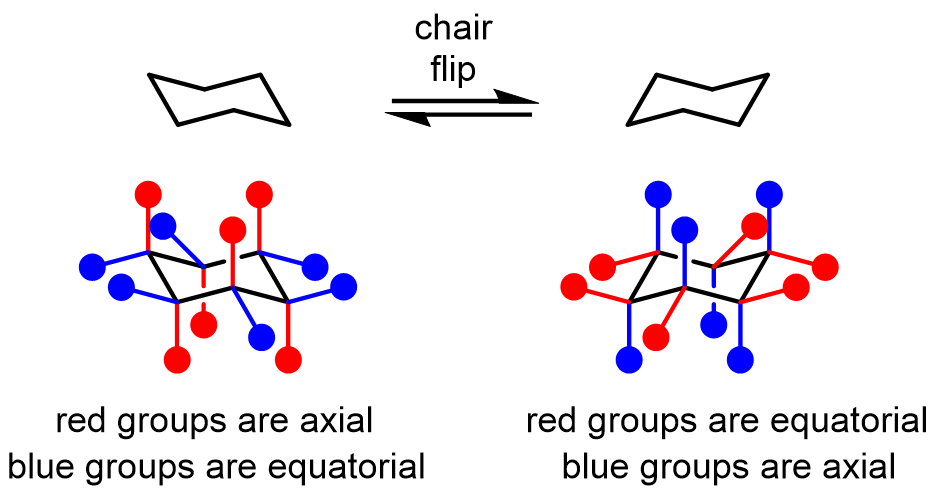
Cyclohexanes undergo a series of conformation changes that can be summarized as a chair flip.
In the chair conformation of cyclohexane, half the substituents on the C atoms are axial and the other half are equatorial. Upon a chair flip, everything axial switches to becoming equatorial and vice versa:
You can perform the flip yourself. Here is a cyclohexane carrying one methyl group:
Try this
- Before dragging, read the color code: every bond keeps its color for the whole flip, and the yellow highlight marks whichever bonds are axial right now. The methyl group starts axial: vertical, and highlighted.
- Drag the CH₃ handle (or the slider) partway. The ring has to climb over the half-chair — the 10.8 kcal/mol summit — before it relaxes into the twist-boat.
- Nudge a little further to the small hump in the middle: the boat, at 6.6 kcal/mol. Notice it is a high point between the two twist-boats, not a resting place.
- Now finish the flip. The methyl group kept its color but lost its highlight: it is equatorial now. Every orange bond did the same, and the blue set picked the highlight up — axial and equatorial traded places wholesale.
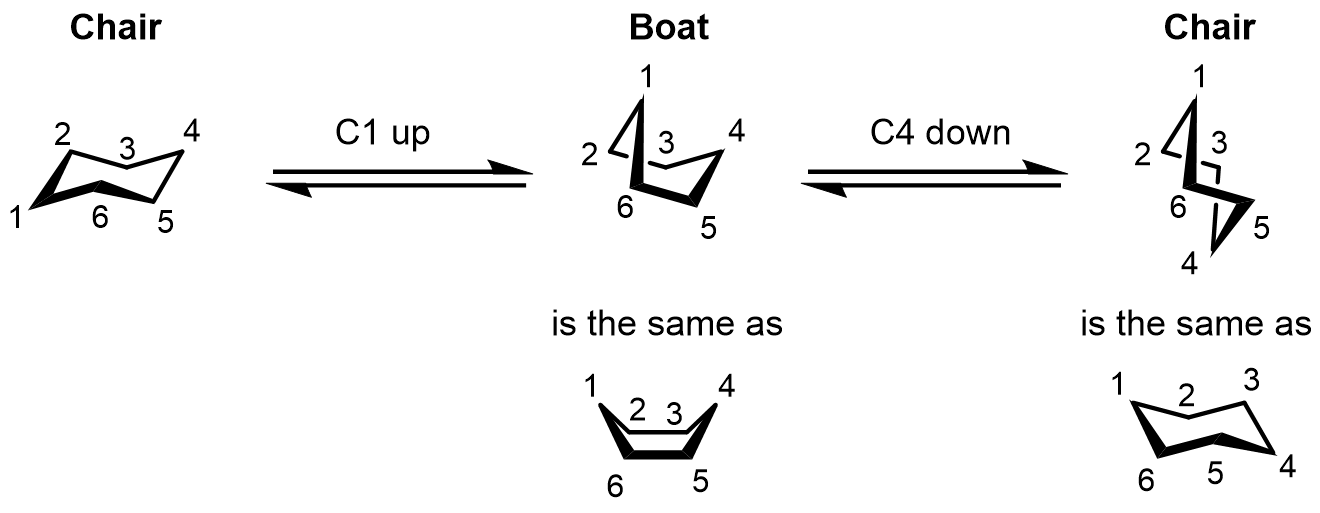
The most significant intermediate conformation during the chair flip process is the boat conformation. Here is a numbered depiction on how to interconvert these conformations:
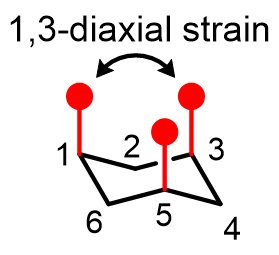
Even though the chair conformation is the lowest energy conformation, there are still repulsive interactions, of which 1,3-diaxial strain is the most important:
Time to drill the flip itself:
Try this
- Check the starting chair first: for each substituent, decide whether it is axial or equatorial. Vertical bonds are axial; bonds angling outward are equatorial.
- Now build the flipped chair by dragging each substituent into its new position. Every axial group must come out equatorial, and vice versa.
- Do one more (New problem). The swap is mechanical once you see it.
Translating line-angle drawings to chairs
Draw the chair both ways
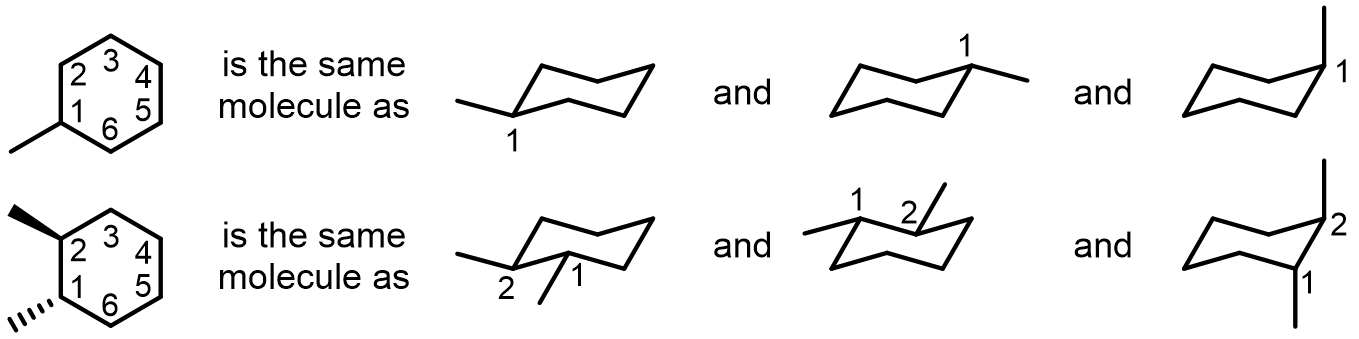
It is important to be able to translate fluidly between line-angle drawing and perspective-style cyclohexane chairs.
Here are some examples, note that these chairs are not all in the same conformation:
A-values and the equatorial preference
Axial or equatorial?
Because of diaxial strain, a general trend is that the lowest energy conformation of a cyclohexane has its largest group equatorial, not axial.
Here are some examples:
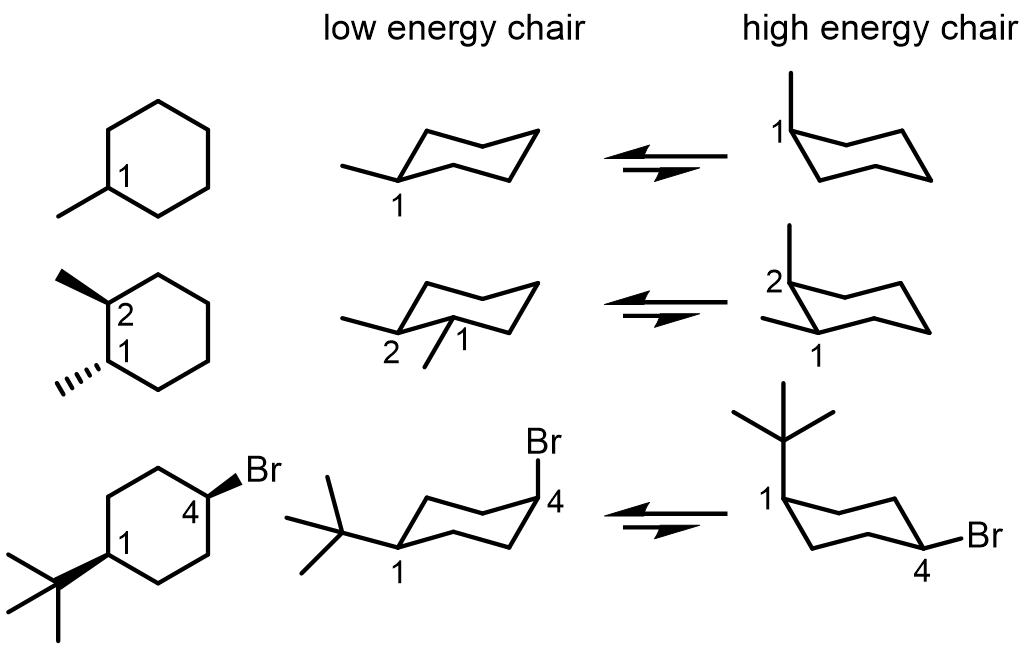
This preference can be quantified by A-values, which indicate the energy cost of placing a group axial instead of equatorial:
The chair conformation with the lower total A-value will likely be the lowest energy conformation of the molecule:
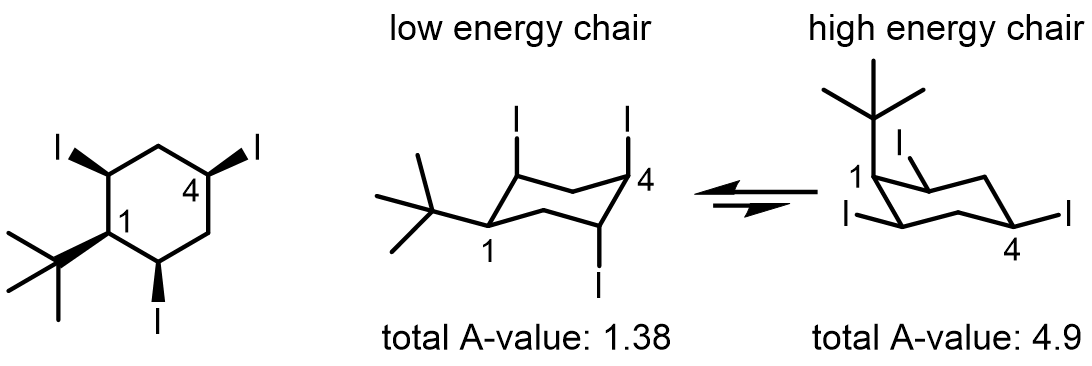
In this case, we would predict the difference in energies of the chair forms would be ~3.5 kcal, which would correspond to an equilibrium ratio of ~368 to 1 at 298 K.
Put the equatorial preference to work:
Try this
- Each problem shows one molecule drawn as both of its chairs. Find the largest group and check where it sits on each side: axial or equatorial?
- Click the lower-energy chair. With a single substituent the call is simple: the chair that puts it equatorial wins.
- Get two more right. With several groups, the one with the largest A-value claims the equatorial spot — a tert-butyl group (A ≈ 4.9 kcal/mol) outranks everything else in the pool.
Spotted an error, or want a topic covered next? Let us know.