Aliphatic (sp3) Elimination Reactions
This guide is an early version — the text is complete, and a few figures are still being redrawn. Spotted something unclear? Let us know.
The question this page answers: What happens if the nucleophile attacks a H beta to leaving group?
Deeper reading: Clayden 2e: Chapter 17 Pages 382–406 — see our chapter-by-chapter practice map for Clayden.
Three mechanisms: E1, E2, or E1cb
When can elimination happen?
Elimination reactions can take place if there is an H located beta to a leaving group. These reactions follow one of three mechanisms: E1, E2, or E1cb.
Overall, a new π bond is created between two atoms in which a leaving group leaves one of the atoms and an H is deprotonated from the other.
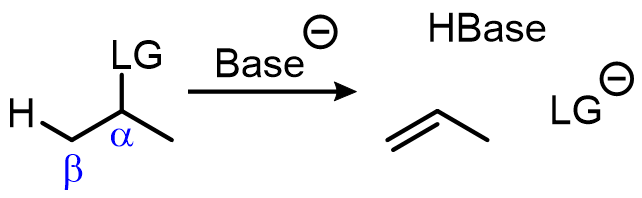
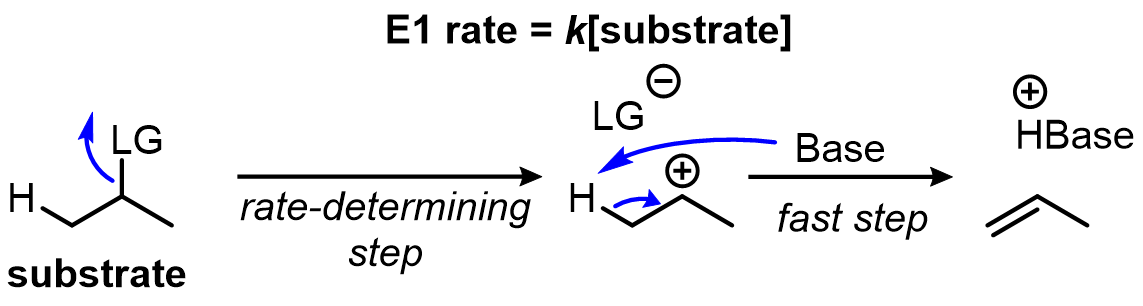
Mechanistically, this can happen in three different ways. If the leaving group leaves first, it is an E1 reaction because the rate-determining step is unimolecular:
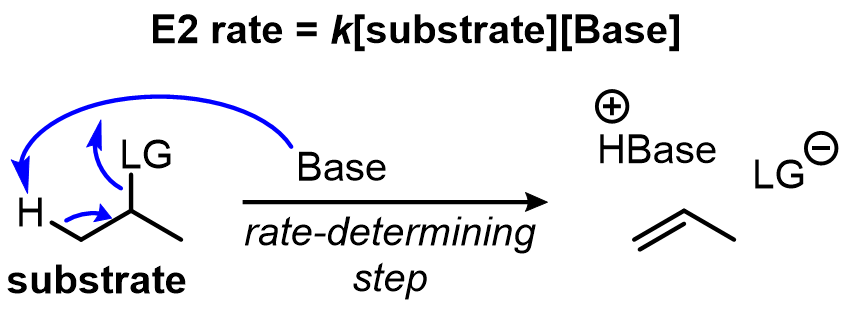
Alternatively, the deprotonation and leaving group leaving can occur at the same time in an E2 reaction, in which there is only one bimolecular step:
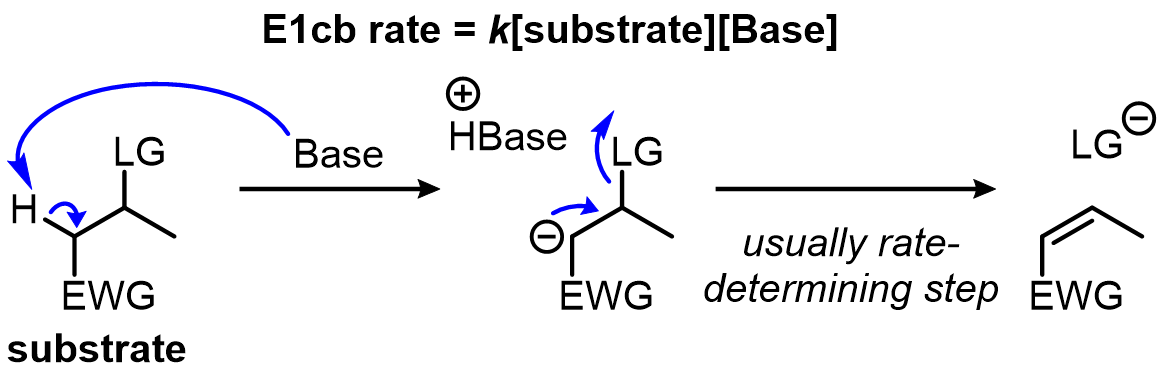
Finally, if the conjugate base of the acidic proton is stabilized, often by an electron-withdrawing group, then an E1cb mechanism (where cb = conjugate base) is more likely:
The E1–E1cb–E2 mechanistic spectrum
What determines the mechanism?
Each β-elimination reaction is somewhere on a mechanistic spectrum of E1--E1cb--E2. Important considerations are:
- Strength of base
- Substrate structure
- Leaving group ability
- Solvent
Strong bases tend to favor E2 and E1cb reactions, while E1 reactions tend to involve weak bases (often just the solvent):

Structures that enable stabilized carbocation formation tend to favor E1 while structures that enable stabilized carbanion formation tend to favor E1cb:

A good leaving group is essential for E1, while it is less impactful for E2/E1cb:

Finally, cation-stabilizing solvents tend to enhance E1 rates while anion-stabilizing solvents tend to enhance E1cb rates.
Stereoselectivity: anti-periplanar preference
Anti- or syn-periplanar?
Stereoselectivity is observed in eliminations, with a preference for anti-periplanar over syn-periplanar.
By a significant margin, anti-periplanar elimination is lower in energy than syn-periplanar because 1) there is much more overlap of the relevant orbitals and 2) the anti-periplanar elimination takes place in a staggered, not eclipsed, conformation:

Regioselectivity: Zaitsev and Hofmann products
More or less substituted alkene?
The regioselectivity of elimination depends on whether the mechanism is E1 or E2.
In E1 reactions, Zaitsev’s Rule dictates that more substituted alkenes (Zaitsev products) are formed preferentially:

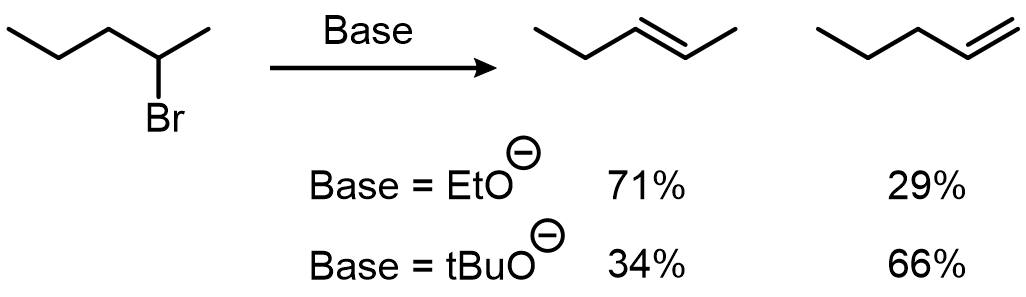
For E2 reactions, beyond Zaitsev’s Rule, Hofmann’s Rule dictates that sterically bulky bases lead to the formation of less substituted alkenes (Hofmann products):
Spotted an error, or want a topic covered next? Let us know.