Carbon-13 NMR Spectroscopy
This guide is an early version — the text is complete, and a few figures are still being redrawn. Spotted something unclear? Let us know.
The question this page answers: How can we gain more information about the arrangement of C atoms in a molecule?
Deeper reading: Clayden 2e: Chapter 3 Page 52–63 — see our chapter-by-chapter practice map for Clayden.
Observing the flipping of nuclear spins
How does NMR work?
Nuclear Magnetic Resonance (NMR) spectroscopy observes the flipping of the spin of atomic nuclei.
In the presence of an external magnetic field, nuclei in different spin states have different energy.
NMR spectroscopy takes advantage of this by
- putting the sample in a large magnetic field
- Irradiating the sample with microwave energy to flip some nuclei from “down” to “up”
- Detecting energy emitted during the relaxation of nuclei back into the “down” state
- Doing complex computational processing
Chemical shift and shielding
What sets the chemical shift?
Differing distribution of electron density around atomic nuclei lead the nuclei to absorb energy at different frequencies.
Multiple factors can influence the frequency at which a nucleus undergoes spin flipping:
- Local chemistry around the nucleus (i.e. what other atoms are bonded nearby)
- Local magnetic fields around the nucleus (more to come later about magnetic anisotropy)
- The element of the nucleus. Each element undergoes spin flips at vastly different energies, making NMR very useful for element-specific measurements.
The energy at which a nucleus undergoes spin flipping is called the chemical shift of the nucleus, measured in ppm units on a so-called delta scale (δ).
Comparing the relative chemical shift of different nuclei provides insight into their relative environments. In general, the more electron density there is around a nucleus, the more shielded it will be, and the smaller (closer to 0) its chemical shift will be.

Typical 13C chemical shift ranges
0–220 ppm, sorted by hybridization
For 13C NMR, typical chemical shifts are observed between 0 and 220 ppm.
Here are general ranges of chemical shifts that are common for 13C NMR:
Another way to categorize these shifts is to start with the hybridization of the C atom, before considering the effects of nearby atoms/functional groups. Here are some sample shifts:

Resonance, inductive, and heavy-atom effects
What moves a 13C shift?
Chemical shifts provide significant insight into molecular structure.
Resonance effects can have significant effects on 13C chemical shifts. Here are examples:
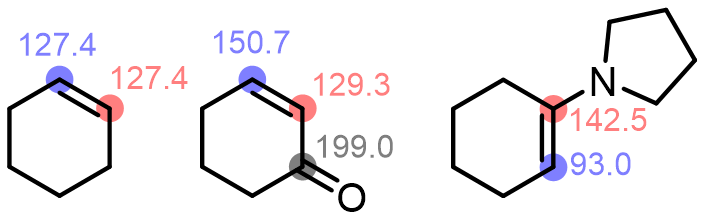
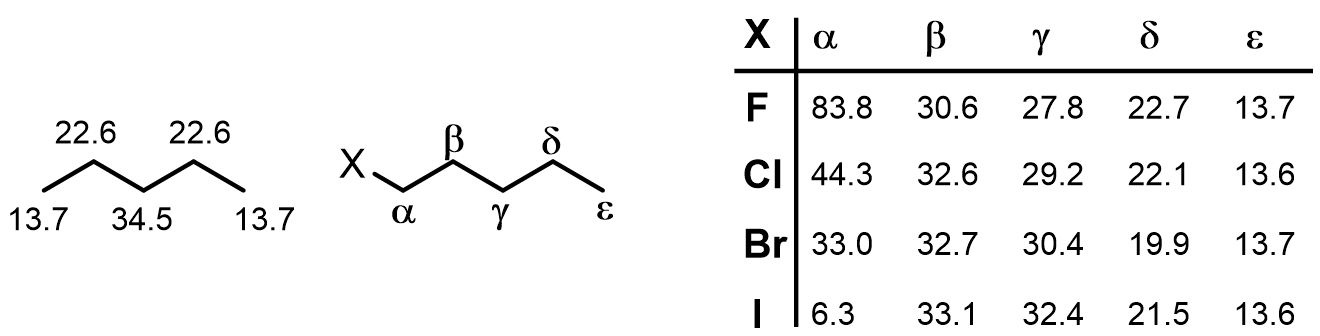
Inductive effects can also matter a lot, here are some examples for pentane vs. halopentanes. Notice how the effects weaken over distance; inductive effects aren’t as influential beyond a three-atom distance:
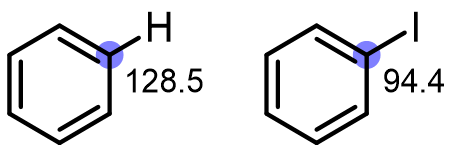
Heavy atoms have large electron shells end up shielding nearby C nuclei as well. This phenomenon is most notable for iodine-containing molecules:
Spotted an error, or want a topic covered next? Let us know.